Big Pharma and Sustainability: Tracking Companies’ Goals 232 views

Pharma companies launch sustainability initiatives for internal operations and their supply chains to help achieve international climate-change goals.

By Patricia Van Arnum, DCAT’s Editorial Director, and Miranda Greenberg, DCAT’s Editorial Coordinator

Global action in motion
International initiatives, such as the Paris Agreement, a global treaty on climate change, and the recent United Nations Climate Change Conference, held in Glasgow, Scotland, in November 2021, have served as an impetus for stakeholders, including companies, to accelerate their sustainability targets. More than 195 countries have signed the Paris Agreement, which set a goal to limit global warming to 1.5°C, compared to pre-industrial levels. To achieve this, the overall goal is to cut greenhouse emissions globally by half before 2030 and to reach net-zero emissions by 2050. “Net-zero” emissions refer to a state in which the greenhouse gases going into the atmosphere are balanced by their removal out of the atmosphere. This goal takes collective action by governments and businesses, and the bio/pharmaceutical industry is part of that effort.

The large bio/pharma companies and their suppliers are part of that effort. Tables I–IV outline the key sustainability targets set by the large bio/pharma companies. Their goals reflect targets to reduce direct greenhouse gas emissions in their own operations (Scope 1 emissions) and indirect greenhouse gas emissions (Scope 2 emissions) that occur from sources that are controlled or owned by an organization (e.g., emissions associated with fuel combustion in boilers, furnaces, and vehicles). Another part of that effort is to reduce so-called “value-chain emissions” (Scope 3). Scope 3 emissions are the result of activities from assets not owned or controlled by the reporting organization, but impacts its value chain, such as those emissions from logistics/transportation of product flows and emissions from suppliers.

Many of the large bio/pharma companies have accelerated their environmental targets to contribute to the long-term international targets to achieve net-zero emissions globally. Highlights from the top 20 bio/pharmaceutical companies are outlined below and in Tables I-IV.  

  Table I:  Large Pharma Companies’ Key Sustainability Goals: AbbVie, Amgen, Astellas Pharma, AstraZeneca, Bayer
AbbVie Reduce absolute carbon emissions 25% by 2025 and achieve 100% zero waste to landfill by 2035.
Amgen By 2027, achieve 100% carbon neutrality (Scope 1 [direct emissions] & Scope 2 (indirect emissions), a 40% additional reduction in water consumption, and a 75% additional reduction in waste disposed.  
Astellas Pharma By fiscal year (FY) 2030, Reduce greenhouse gas (GHG) emissions (Scope 1 [direct] and Scope 2 [indirect]) by 30% from FY 2015 baseline. By FY 2030, reduce Scope 3 emissions (value-chain emissions) by 20% from 2015 baseline.
AstraZeneca Eliminate carbon emissions from its global operations by 2025 and to ensure its entire value chain is carbon negative by 2030. By 2025, to achieve zero carbon, convert 100% of its energy consumption to renewable sources for both power and heat, and have a 100% electric vehicle fleet. By 2030, engage suppliers to reduce their direct emissions and identify carbon removal options with the goal of becoming carbon negative across its entire value chain.
Bayer* Achieve climate neutrality by 2030 (Scopes 1 [direct] and 2 [indirect] and net zero emission across its entire value chain (Scopes 1, 2 and 3) by 2050. This involves by 2030 to reduce CO2 emissions from its own business operations by 42% (base year 2019) in absolute terms and Scope 3 (value chain emissions) by 12.3% in absolute terms as well as to source 100% of procured electricity from renewable energies by 2030.
Note: Bayer’s sustainability targets and performance from across all businesses: pharmaceuticals, crop protection, and consumer healthcare.  
Source: Company information

Highlights from AstraZeneca, Amgen, Bayer
AstraZeneca.
 AstraZeneca has dubbed its strategy for achieving net-zero emissions as “Ambition Zero Carbon.” In January 2020, AstraZeneca provided details of that strategy, which involves plans to invest $1 billion to achieve zero-carbon emissions from its global operations by 2025 and to ensure that its entire value chain is carbon-negative by 2030.

In order to achieve zero carbon by 2025, AstraZeneca plans to reduce total energy consumption by 10%, double energy productivity (based on a 2015 baseline), convert 100% of its energy consumption to renewable sources for both power and heat, and have a 100% electric fleet. In addition, the company has pledged to engage its suppliers to reduce their direct emissions through 2030 and identify carbon removal options that will lead to more carbon dioxide removed from the atmosphere than added to it. This will result in AstraZeneca becoming carbon negative across its entire value chain by 2030. To achieve that, the company aims to reduce selected Scope 3 emissions (i.e., value chain emissions) by 20% from 2015 to 2025.

In addition, the company has set a goal by 2025 to develop near-zero Global Warming Potential (GWP) propellants for pressurized metered-dose inhalers used in its respiratory products. AstraZeneca expects the propellant used in the next generation inhalers to have a GWP that is 90-99% lower than propellants used in older products.

The company is also involved in a reforestation plan as trees naturally remove carbon dioxide and can mitigate the effects of climate change. The company is partnering with reforestation organizations and governments in a number of countries to plant 50 million trees over the next several years; the first programs started in 2020.

Amgen. The “Road to Net Zero,” Amgen’s set of environmental sustainability targets, focus on achieving carbon neutrality from its operations, further reducing water use by 40%, and reducing waste disposal by 75% by 2027. Amgen’s 2027 environmental sustainability targets are designed to track the plan’s progress using a baseline taken from performance in 2019. This was because impacts from COVID-19 resulted in atypical results in 2020. Amgen’s approach to achieving carbon neutrality has a primary focus on innovative and efficient technologies to reduce and eliminate carbon emissions from Amgen-owned operations and procurement of renewable energy. For operations in which carbon emissions cannot be eliminated, Amgen supports additional environmental and sustainability projects that sequester or avoid greenhouse gas emissions. Additionally, Amgen’s plan includes engaging with its partners to assist with and encourage carbon reductions throughout its value chain.

Bayer. Bayer has set a goal of achieving net-zero emissions in its entire value chain (Scopes 1, 2, and 3) by 2050 and to be climate neutral (Scopes 1 and 2) by 2030. To achieve this, it has set a goal of reducing CO2 emissions from its own business operations by 42% (base year 2019) in absolute terms and Scope 3 (value chain emissions) by 12.3% in absolute terms as well as source 100% of procured electricity from renewable energies by 2030. These targets apply to all of Bayer’s businesses: pharmaceuticals, crop protection, and consumer healthcare.

In 2020, the company undertook a Scope 3 (value chain emissions) analysis to identify relevant reduction potentials. Possible implementation measures include giving suppliers incentives to use electricity from renewable energies, further optimizing logistics, and reducing packaging. Bayer is a member of the Together for Sustainability industry initiative, which provides a framework for assessing and auditing sustainability performance of supply chains for chemical companies and their suppliers through a shared infrastructure. Bayer heads up a working group on emissions reduction in the supply chain under that initiative.

Last month (December 2020), Bayer announced it is investing EUR 100 million ($113 million) for sustainable packaging in its Consumer Health Division to reach a target that 100% of Bayer Consumer Health’s packaging will be recyclable or reusable by 2030 and all packaging will include consumer-friendly recycling information. Within the same timing, the division’s packaging will include an average of 50% recycled content, and 100% of purchased paper will be sustainably sourced. Progress to-date includes: having shipping boxes include 80% recycled content by the end of 2021; started conversion of paper packaging across global brands to use certified paper from responsibly managed forests; implemented programs to transition to digital marketing and reduce the footprint of the division’s printed promotional materials; and assess 100% of new product development projects for sustainability performance across health, the environment, and product access.

  Table II: Large Pharma Companies’ Key Sustainability Goals: Biogen, Boehringer Ingelheim, Bristol-Myers Squibb, Lilly, Gilead Sciences
Biogen By 2032, reduce absolute Scope 1 (direct) and Scope 2 (indirect) greenhouse gas (GHG) emissions 55% from a 2019 base year. By 2040, reduce GHG emissions by 100% from a 2019 base year.
Boehringer Ingelheim By 2030, become carbon neutral in company operations: Scope 1 (direct) emissions and Scope 2 (indirect) emissions. Further reduce its overall water footprint, operational waste to landfill and resource use. Apply eco-design and green-chemistry concepts to all new products.
Bristol-Myers Squibb Be carbon neutral in its Scope 1 (direct) and Scope 2 (indirect) emissions and reach targets of equitable water use, zero waste to landfill, and 100% electric vehicles in its fleet by 2040. These goals include 10% reduction in energy-use intensity and greenhouse gas emissions intensity, 25% reduction in waste to landfill, and 5% reduction in water intensity. Purchase 100% of the electricity it uses from renewable sources by 2030.
Eli Lilly and Company By 2030, be carbon neutral in in its own operations: Scope 1 (direct) and Scope 2 (indirect) emissions. Secure 100% of purchased electricity from renewable sources and enhance tracking and reporting of emissions from its full value-chain.
Gilead Sciences By 2025, reduce greenhouse gas emissions across Scope 1 (direct) emissions and Scope 2 (indirect) emissions by 25%, compared with its 2016 baseline.  
Source: Company information

Highlights from Biogen, Bristol-Myer Squibb, Lilly
Biogen
. In 2014, Biogen became carbon neutral by matching 100% of its electricity with renewable electricity (via unbundled renewable energy credits) and retiring carbon offsets (from certified landfill gas to energy projects) against the remainder of its Scope 1, 2 and 3 emissions. Following new guidance that avoided emission carbon offsets (i.e., offsets that still involve emitting activity as compared to

a negative emitting activity, which are referred to as “negative emission carbon offsets/credits”), which are not consistent with the Paris Agreement, Biogen re-evaluated its carbon neutral strategy and moved away from carbon offsets in 2019. While its long-term objective is to become fossil-fuel free, it says it may use both avoided emission and negative emission carbon offsets/credits in the short term as part of its overall climate strategy. It The company has set a goal of reducing absolute Scope 1 (direct) and Scope 2 (indirect) greenhouse gas emissions 55% by 2032 and 100% by 2040 from a 2019 base year. This new target is deemed consistent with reductions required to keep warming to 1.5°C, as outlined in the Paris Agreement.

As with other companies, green chemistry plays a role in Biogen’s sustainability strategy. In 2020, the company established formal green processes and standardized metrics across all modalities and for every drug it develops. The company’s small-molecule group began that process in late 2020 with other modality groups to follow in 2021.

Bristol-Myers Squibb. Last month (December 2020), Bristol-Myers Squibb updated its sustainability strategy on a global basis by setting new 2030 and 2040 goals. By 2030, the company will purchase 100% of the electricity it uses from renewable sources, and by 2040, it will be carbon neutral in its Scope 1 (direct) and Scope 2 (indirect) emissions and reach the targets of equitable water use, zero waste to landfill, and 100% electric vehicles in its fleet.

Eli Lilly and Company. Eli Lilly and Company has set several key sustainability targets for 2030: achieve carbon neutrality in in its own operations—Scope 1 (direct) and Scope 2 (indirect) emissions; secure 100% of purchased electricity from renewable sources; and enhance tracking and reporting of emissions from its full value chain. Although the company currently does not have specific reduction targets for Scope 3 greenhouse gas emissions (value-chain emissions), it is expanding the transparency and quality of related data and disclosures to identify opportunities to reduce its overall footprint as reflected in its 2030 goals.

  Table III: Large Pharma Companies’ Key Sustainability Goals: GlaxoSmithKline, Johnson & Johnson, Merck & Co., Novartis, Pfizer
GlaxoSmithKline* Reach net zero carbon by 2030 through several targets. By 2030, achieve net zero Scope 1 (direct) and Scope 2 (indirect) emissions across all its Biopharma and Consumer Healthcare* operations. By 2030, achieve net zero emissions across its entire value chain for its Biopharma business and select consumer healthcare brands/formats. By 2025, use 100% renewable electricity for Biopharma business and Consumer Healthcare* businesses.
Johnson & Johnson* By 2045, achieve net zero carbon emissions across its value chain. By 2030, achieve carbon neutrality for its operations by reducing absolute Scope 1 (direct) and Scope 2 emissions (indirect) 60% from 2016 levels. By 2030, reduce absolute upstream value chain (Scope 3) emissions 20% from 2016 levels to deliver nearly 2.5 times the carbon footprint reduction compared to that of its own operations. By 2025, source 100% of electricity needs from renewable sources.
Merck & Co. By 2025, achieve carbon neutrality across its operations. By 2030, reduce Scope 1 (direct) and Scope 2 (indirect) emissions 46% and Scope 3 (value-chain) emissions 30% by 2030.
Novartis Achieve net zero emissions by 2040. By 2025, become carbon neutral in its operations: Scope 1 (direct) and Scope 2 (indirect) emissions. Be carbon neutral across its entire value chain (Scopes 1, 2 and 3) by 2030 and be plastic- and water-neutral by 2030.
Pfizer By 2030, be carbon neutral across internal operations, including reducing Scope 1 (direct) and Scope 2 (indirect) emissions by 46% from a 2019 baseline and influence reductions in its value-chain emission by 2025. By 2030, purchase 100% renewable energy.
*Note: GlaxoSmithKline has announced plans for the demerger of its Consumer Healthcare business, to take effect in mid-2022.
**Note: Targets for all of J&J. In, November 2021, company announced plans to split the company into two separate, standalone publicly traded companies, one focused on pharmaceuticals and medical devices, and the other on consumer health, effective 18-24 months from date of announcement.
Source: Company information.

Highlights from GSK, J&J, Merck & Co., Novartis, Pfizer
GlaxoSmithKline.
 GlaxoSmithKline (GSK) has set a goal of achieving net-zero carbon emissions by 2030 through several targets. By 2030, it aims to achieve net-zero Scope 1 (direct) and Scope 2 (indirect) emissions across all its Biopharma and Consumer Healthcare operations. By 2025, it has targeted 100% renewable electricity for its Biopharma business and Consumer Healthcare businesses. By 2030, it is targeting net zero emissions across its entire value chain (Scope 3 emissions) for its Biopharma business and select consumer healthcare brands/formats.

Last September (September 2021), GSK announced updates on efforts to achieve the company’s environmental goals, including new investment in renewable electricity at global manufacturing sites in the UK and US and a new initiative to reduce greenhouse gas emissions from its rescue-metered-dose asthma inhalers, which account for almost half of the company’s carbon emissions.

GSK is investing £50 million ($68 million) in the UK and US manufacturing sites to secure renewable power generation to support the target of sourcing 100% of global electricity usage from renewables by 2025. At its Irvine manufacturing facility in Scotland, the largest consumer of energy in the GSK global network, the company will invest in a long-term project for two new wind turbines: a 56- acre solar farm through a new 20-year power purchase agreement with its partner, The Farm Energy Company. The project will save 10,000 metric tons of CO2 annually and make a major contribution to reaching 85% onsite energy generation (55% from renewables). In addition, at Oak Hill in New York, a manufacturing facility in GSK’s Consumer Healthcare network, GSK is invested in solar energy production to achieve a target goal by the end of 2021 of converting 70% of power consumption to solar energy. GSK estimates that it has reduced carbon emissions in its operations by 10% over the last year, including switching to renewable energy for its Wavre vaccine site in Belgium.

GSK also announced last September (September 2021) that it has initiated an R&D program to redevelop and redesign its metered dose inhalers. A new lower greenhouse gas propellant is in preclinical assessment, with the potential to reduce greenhouse gas emissions from its inhalers by 90%. Approximately 45% of GSK’s carbon emissions come its metered dose inhalers.

Johnson & Johnson. Johnson & Johnson (J&J) has set an overall goal to achieve net-zero carbon emissions across its value chain by 2045. To reach this goal, it seeks to achieve carbon neutrality for its operations by 2030 by reducing absolute Scope 1 (direct) and Scope 2 emissions (indirect) 60% from 2016 levels. By 2030, it has set a target to reduce absolute upstream value chain (Scope 3) emissions 20% from 2016 levels to deliver nearly 2.5 times the carbon footprint reduction compared to that of its own operations. By 2025, it plans to source 100% of its electricity from renewable sources.

The company says it will achieve these goals through five main areas: (1) advancing energy and process efficiency; (2) sourcing renewable electricity (the company currently sources 50% of its electricity from renewable sources; (3) sourcing renewable heat (company is developing renewable heating systems and  investigating zero-/low-carbon fuel use); (4) working with suppliers to develop emission-reduction targets; and (5) using nature-based climate solutions, such as carbon compensation and removal partnerships.

Merck & Co. Last April (April 2021),Merck & Co. announced goals to achieve carbon neutrality across its operations by 2025 and reduce its value-chain emissions by 30% by 2030. Merck says it will achieve carbon neutrality by increasing efficiency, reducing carbon emissions, applying sustainable building standards, and continuing to transition away from fossil-fuel use. Remaining Scope 1 emissions, which are direct greenhouse (GHG) emissions that occur from sources that are controlled or owned by an organization (e.g., emissions associated with fuel combustion in boilers, furnaces, vehicles), will be offset each year with a portfolio of carbon credits, including carbon removals.

Merck is also accelerating its previous 2040 goal by 15 years to source 100% renewable energy for its purchased electricity. Merck signed three new virtual power purchase agreements for utility-scale energy projects based in Texas and Spain. These projects will address approximately 35% of Merck’s Scope 2 emissions by collectively adding 145 megawatts of solar and wind energy to the grid. Scope 2 emissions are indirect greenhouse emissions associated with the purchase of electricity, steam, heat, or cooling.

To achieve the 30% reduction in Scope 3 emissions (i.e., value-chain emissions) by 2030, Merck says it will continue to engage with its suppliers to reduce their emissions, promote opportunities for suppliers to source renewable energy, and use existing procurement and supply-chain processes to drive additional ways to decrease emissions. Scope 3 emissions are the result of activities from assets not owned or controlled by a reporting organization, but that the organization indirectly impacts in its value chain.

Last month (December 2021), Merck announced its inaugural issuance of a $1-billion sustainability bond, which was part of an $8-billion underwritten public offering of notes that closed on December 10, 2021. Merck intends to use the net proceeds from this bond offering to support projects and partnerships in the company’s priority environmental, social, and corporate governance (ESG) goals. The bond transaction is in line with Merck’s newly introduced Sustainability Financing Framework, which facilitates the company’s use of sustainable capital markets to finance or refinance eligible projects that align with its ESG commitments.

Novartis. Novartis has an overall goal to achieve net-zero emissions by 2040. To achieve this goal, by 2025, it is seeking to become carbon neutral in its operations: Scope 1 (direct) and Scope 2 (indirect) emissions and be carbon neutral across its entire value chain (Scopes 1, 2, and 3) by 2030. It has also set a goal of becoming water- and plastic-neutral by 2020.

To achieve these targets, the company has an energy-management program that first involves right-sizing its business and improving energy efficiency; using renewable energy sources, such as wind and solar; and, finally, offsetting unavoidable emissions via carbon sequestration projects, such as tree planting. To increase its use of renewable energy, it has decarbonized its procured electricity in the US and Europe through the use of virtual power purchase agreements and also invested in four carbon offset projects in South America, Africa, and China.

As part of a supplier qualification process as it relates to sustainability, suppliers are required to disclose information and outline targets as it relates to emissions and water usage. Novartis works with various groups, including the Science-Based Target Initiative, the Carbon Disclosure Project, EcoVadis, and the Pharmaceutical Supply Chain Initiative. The qualification process is the first step and is followed by an implementation phase, with concrete actions and continuous improvements. In 2021, the company planned to release a dedicated Suppliers’ Sustainability Playbook to provide guidance to suppliers on how to efficiently manage the qualification and implementation phases and contribute to Novartis’ environmental sustainability targets. Based on the stage reached in the qualification and implementation phases, respectively, Novartis will assign a maturity level to each supplier to facilitate an open, transparent, and motivating environment for continuous improvement.

Pfizer. Pfizer has set goals to be carbon neutral across internal operations by 2030, including reducing Scope 1 (direct) and Scope 2 (indirect) emissions by 46% from a 2019 baseline. It is also targeting influencing reductions in its value-chain emission by 2025 by catalyzing suppliers to establish science-based targets by 2025. In addition, by 2030, it has set a goal to purchase 100% renewable energy.

In March 2020, Pfizer launched a $1.25-billion sustainability bond, which the company says was the first to be issued by a bio/pharmaceutical company. Proceeds from the bond will be used for meeting the company’s overall sustainability goals, including those related to environmental impact; increasing access to Pfizer’s products, especially to underserved populations; and the company’s overall social impact. In addition, in 2021, the company launched a $1-billion sustainability bond to help fund COVID-19 vaccine expenses.

  Table IV: Large Pharma Companies’ Key Sustainability Goals: Roche, Sanofi, Takeda, Teva Pharmaceuticals, Viatris
Roche Reduce the environmental impact of its operations and products by 50% from 2020–2029, compared to 2019. By 2029, achieve a 50% reduction of total environmental impact (eco-balance for operations and product stewardship score (based on internal company criteria) for products. By 2050, achieve real* zero greenhouse gas emissions for Scope 1 (direct) and Scope2 (indirect) emissions. By 2050, reduce Scope 3 (value chain) emissions.
Sanofi By 2030, achieve carbon neutrality across its entire value chain and achieve a 55% reduction of direct greenhouse emissions related to its operations (Scopes 1 [direct] and 2[indirect] emissions). Limit environmental footprint and improve environmental profile of products. Key targets include: use eco-design for 100% of new products by 2025; use 100% of renewable electricity at all sites by 2030 and achieve a 100% carbon-neutral car fleet by 2030.
Takeda By 2024, help 67% of its suppliers establish their own science-based emission targets. By 2025, reduce greenhouse gas emissions in company-wide operations by 40% (using FY 2016 baseline) and 15% for Scope 3 (value-chain) emissions (using FY 2018 baseline). By 2040, be carbon zero in its operations without using offsets for Scope 1 and 2 emissions and be carbon neutral across its value chain by reducing Scope 3 emissions by 50% from FY2018 baseline and offsetting remaining emissions.
Teva Pharmaceuticals By 2030, reduce Scope 1 (direct) and 2 (indirect) greenhouse gas emissions by 33% vs. 2017 levels. By 2030, reduce Scope 3 (value-chain) emissions by 25%. By 2030, increase energy efficiency by 10% and the total proportion of energy purchased or generated from renewable sources to 50% and reduce total water withdrawal by 10% in water-stressed areas.
Viatris Increase the use of renewable energy by more than 400% in five years (as reported in May 2021) and achieve zero-waste to-landfill at two additional facilities in India, to bring its global total to 13 sites with this status.
*Note: Roche’s goal of achieving “real” zero greenhouse gas emissions refer to actual emissions reductions without offsetting through CO2 reduction certificates.
Source: Company information

Highlights from Roche, Sanofi, Teva
Roche. 
In 2019, Roche began the process to develop and define new safety, health, and environmental goals for the next five years, with 2020 being the base year to compare with in 2021–2025. (Note: in 2021, the company changed the reference year to 2019 for some of the goals and correspondingly adjusted these goals because of distortions in the numbers in 2020 due to the COVID-19 pandemic).

Roche has begun a 10-year goal to reduce the environmental impact of its operations and products by 50% from 2020–2029, compared to 2019 levels. This involves, by 2029, achieving a 50% reduction of total environmental impact (eco-balance for operations and product stewardship score, based on internal company criteria) for products. Longer term, by 2050, it has set a goal to achieve real-zero greenhouse gas emissions for Scope 1 (direct) and Scope 2 (indirect) emissions. “Real-zero” greenhouse gas emissions refer to actual emissions reductions without offsetting through CO2 reduction certificates. By 2050, it is seeking to reduce Scope 3 (value chain) emissions.

Sanofi. Sanofi has a goal to achieve carbon neutrality by 2030 and achieve a 55% reduction of direct greenhouse emissions related to its operations (Scopes 1 [direct] and 2 [indirect] emissions). It is also seeking to improve the environmental profile of its products. Key targets include use of eco-design for 100% of new products by 2025, use of 100% of renewable electricity at all sites by 2030, and achieving a 100% carbon-neutral car fleet by 2030.

To help finance its sustainability projects, which include environmental targets as well as societal projects, such as increasing access to medicines, last month (December 2021), Sanofi announced two sustainability-linked revolving credit facilities: (1) a new EUR 4-billion ($4.3-billion) revolving credit facility expiring December 2025, with two extension options of one year each and (2) an amendment of EUR 4 billion ($4.3-billion) revolving credit facility that expired in December 2021 with the addition of two extension options of one year each.

Sanofi first signed a sustainability-linked loan in 2020 with 16 lenders, and the new sustainability-linked credit facilities reflects its strategy to become an active repeat issuer of sustainable finance instruments. In addition, in December (December 2021), the company issued its Sustainability-Linked Bond Framework to outline its criteria and goals for sustainability-linked bonds.  

For value-chain emission reductions, Sanofi has also partnered with nine other bio/pharmaceutical companies to facilitate suppliers’ adoption of 100% renewable electricity and reducing greenhouse gas emissions through the ENERGIZE program. Members also include AstraZeneca, Biogen, GSK, J&J, Merck, Novartis, NovoNordisk, Pfizer, and Takeda. Companies in the program support suppliers in reducing their Scope 2 greenhouse gas emissions, i.e., the electricity companies buy, which in turn will reduce Scope 3 emissions, those that occur throughout the value chain such as transportation and distribution. The program is designed to enable pharmaceutical suppliers to learn more about renewable energy adoption and contracting. This gives suppliers, which may not otherwise have the internal resources or expertise available, the opportunity to participate in the market for power purchase agreements.

Teva Pharmaceutical Industries. Teva has set a goal by 2030 to reduce Scope 1 (direct) and 2 (indirect) greenhouse gas emissions by 33% vs. 2017 levels. It has also set a 2030 target to reduce Scope 3 (value-chain) emissions by 25%. Together, these environmental targets aim to reduce emissions across Teva’s value chain in line with the Paris Climate Agreement.

To meet these goals, last November (November 2021), the company issued a $5-billion sustainability-linked bond, the proceeds of which are linked to three targets, including a 25% reduction in Scope 1 and 2 greenhouse gas emissions and a 150% increase in access to essential medicines for patients in low- and middle-income countries by the end of 2025. Teva says that the $5-billion bond is the largest of its kind from any sector and the first issued by a generic-drug company.

Electronic afterlife: Opportunities in global e-waste recycling 230 views

What is E-Waste? 

In today’s fast-paced world, technology advances at an astonishing rate, rendering our electronic devices obsolete in the blink of an eye. E-waste, a realm where hidden fortunes and lurking dangers intertwine, is the world’s fastest growing and the most valuable waste stream. Within this rapidly growing waste stream lies a treasure trove valued at a staggering $62.5 billion USD, brimming with precious metals waiting to be mined. With less than 20 percent of global e-waste currently undergoing formal recycling, discarded electronic devices, once cherished and now non-functional or unwanted, hold the key to significant untapped potential. IT and Consumer Electronics stands as the primary focus within e-waste recycling. This includes electronic devices commonly found in corporate offices, schools, and households. Computers, tablets, servers, televisions, and cell phones hold the promise of being repaired and refurbished into fully functional devices, fetching prices that surpass the mere sum of their raw materials. 

This category of electronics not only has the potential for refurbishment but also serves as a concentrated source of precious metals like gold, silver, and platinum. Additionally, it contains other recyclable commodities such as glass and plastic. Approximately 60 percent of e-waste is comprised of valuable metals, while plastics make up 15 percent, and delicate glass components account for 12 percent. By recycling these electronics, we not only recover valuable resources but also contribute to the sustainable management of e-waste. 

However, amid the allure of riches, a hidden danger lurks. E-waste carries a dual identity, harboring hazardous chemicals like lead, mercury, cadmium, arsenic, and beryllium. Safely recycling these valuable components becomes a complex and costly endeavor, necessitating careful handling to protect both the environment and human health. 


Informal E-Waste Recycling  

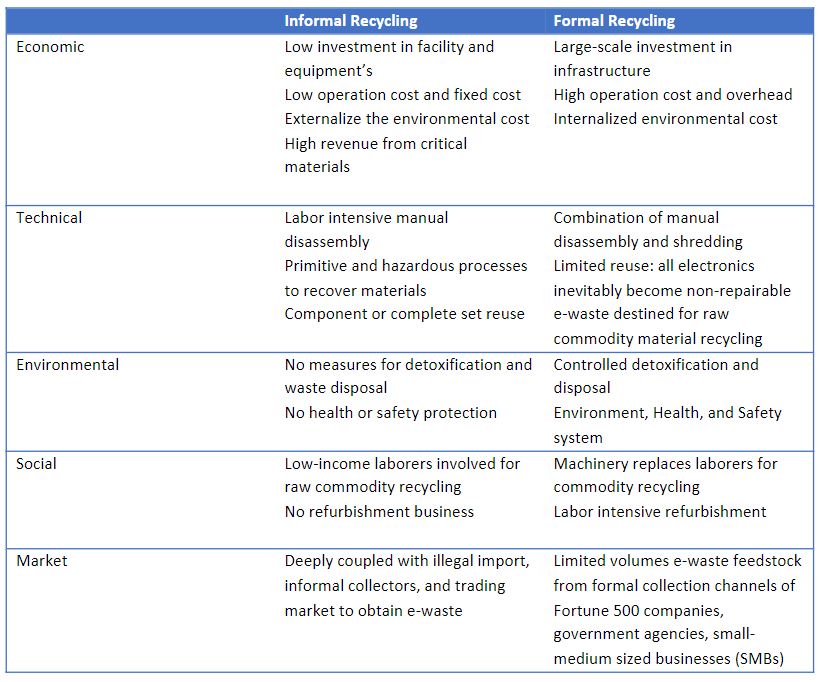
In e-waste recycling, metals have a significant recycling advantage over plastics. The distinct properties of metals, including their different densities, colors, and electrical and magnetic properties, make it easier for humans and machines to separate them from other materials. Meanwhile, plastics pose a greater challenge due to their similar properties, overlapping densities, and any plastic can be any color. As a result, the recycling of e-waste metals surpasses that of plastics. 

To cope with the difficulty of separating the metals from plastics in e-waste, many organizations in high income countries resort to exporting their e-waste to developing countries for informal recycling. This informal economy thrives in regions such as Central America, Northern Africa, and Southeast Asia, where laborers engage in hazardous practices to extract metals from obsolete electronics. Burning obsolete electronics without protective equipment, manually stripping metals, and discarding unsalable parts into bodies of water pollute the environment and pose severe health risks to nearby communities. 

80 percent of the world’s e-waste is processed through this informal economy, concentrating in countries like Ghana, Nigeria, Pakistan, India, and China. These regions become attractive import destinations for unmonitored e-waste, as companies label their shipments as “reusable” or “donations” to avoid the higher costs of formal e-waste recycling domestically. The consequences of informal e-waste recycling include toxic pollution in food, water, and air, perpetuating a dangerous cycle of environmental degradation jeopardizing human health.  


Formal E-Waste Recycling 

Within formal electronics recycling lies an industry known as IT Asset Disposition (ITAD), where safe transformation unfolds. ITAD companies breathe new life into discarded gadgets and safeguard sensitive data, all while reaping the hidden treasures within. The ITAD industry concentrates in North America, Western Europe, and Asia-Pacific.   

At the heart of ITAD lie three essential services: data sanitization, repair and refurbishment, and the transformation of electronics into raw commodities. The journey begins with the careful sorting of e-waste into different categories, such as desktops, laptops, tablets, servers, and keyboards. Each device is then evaluated for functionality, considering its physical condition and responsiveness. Those that pass the assessment undergo a data removal process, where data-bearing assets are thoroughly cleansed without causing damage to the hardware. Once functional components are removed, they are repurposed for in-house refurbishment, sold to wholesalers, or made available on platforms like eBay. 

For electronics that cannot be repaired or reused, a meticulous shredding process comes into play. Prior to shredding, all hazardous components are carefully removed and sent for specialized recycling. The shredder then reduces the remaining electronic material into smaller pieces, typically 1.5-to-2.5 inches in size. These fragments are mechanically sorted through vibrating screens, magnetic separation, eddy current separation, and density separation. The resulting metal outputs are sent to smelters, while the plastics find their way to compounders. Ultimately, the recycled e-waste commodities find their place predominantly in European and Asian markets.


Informal Versus Formal Recycling  


Global Methyl Methacrylate (MMA) Market Snapshot 155 views

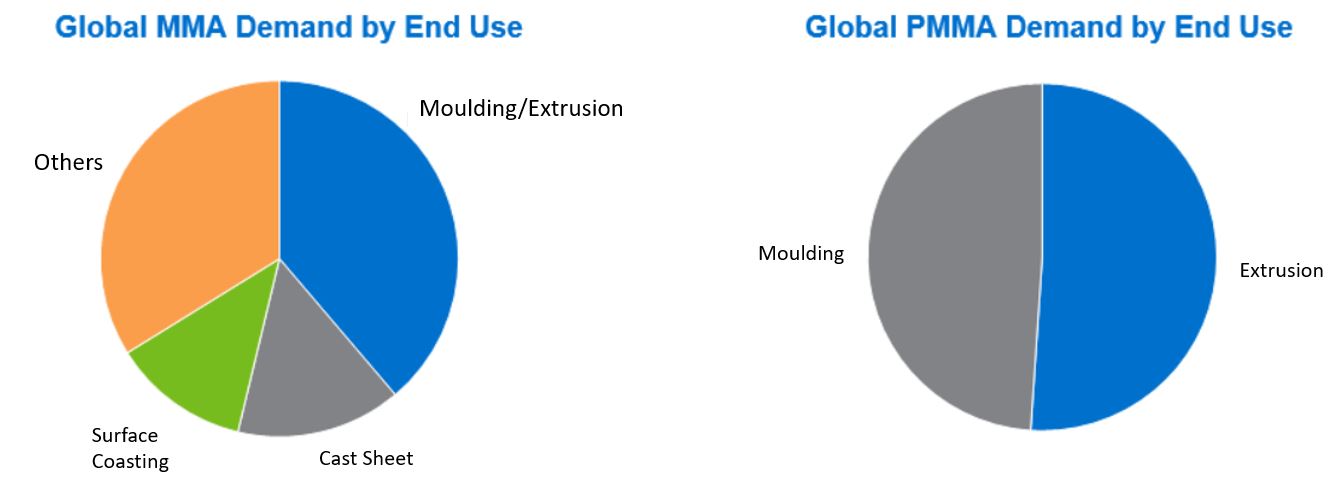
Methyl methacrylate (MMA), also referred to as 2-methyl acrylic acid methyl ester or 2-methyl-2-propenoic acid methyl ester is a key intermediate chemical, due to its ability to undergo polymerization and copolymerization.  Polyacrylates, a family of clear and relatively durable thermoplastics, are the major source of demand for MMA.   

The largest single application for MMA is in the production of polymethyl methacrylate (PMMA).  PMMA is a hard, rigid and transparent polymer.  It absorbs very little visible light, and it is a polar material with a rather high dielectric constant and power factor.  PMMA has a good water resistance, and has good resistance to alkalis, aqueous inorganic salts and dilute acids.  PMMA has outstanding outdoor weather resistance, markedly superior to other thermoplastics.   

PMMA is best known through its various trade names: Plexiglas, Lucite and Perspex.  The main end-uses for PMMA resin are in sheet extrusion and moulded products. Extruded acrylic sheet is used in a variety of applications such as displays and signage, glazing, lighting and miscellaneous other uses.  Moulded PMMA resin is used in parts for motor vehicles, electrical appliances and optical applications as well as a variety of homewares and consumer goods. Its major advantages are excellent optical properties and transparency, weatherability, light weight, impact resistance, chemical resistance, electrical resistance, and workability.  The largest sectors for PMMA are in construction, advertising displays and signage, appliances, automotive and optical media.  


In general, MMA and PMMA are used in a wide range of industries, with the largest end-markets being the construction and automotive industries. The diversity of the end-markets for these products means that overall demand growth tends to follow GDP.  Therefore demand for MMA and PMMA is expected to grow at an annual average rate of 3.2 and 3.0 percent, respectively, from 2022 to 2035.  Market demand is greatly influenced by general economic conditions, and the development of new technologies and products. 

Three primary processes have been commercialized to produce MMA. These are based on acetone cyanohydrin (ACH), the i-C4 (or isobutylene) route, and Lucite’s Alpha process.  However, in response to market needs for green and renewable products, MMA producers and technology developers are researching and developing more sustainable technologies to produce MMA.  A few industry players, such as Mitsubishi Chemical Corporation (through its Lucite subsidiary), Evonik, Ascenix and Arkema, have announced the development of bio-MMA processes; although these technologies are yet to be commercialized.  However, it is worth mentioning that several of the key bio-based feedstocks of MMA are now commercially available. 

Global MMA capacity exceeds 6 million tons, while PMMA is over 2 million tons in 2022.  Asia Pacific accounts for about 70 percent of the global capacity.  In recent years, capacity addition has been focused in Asia Pacific, primarily China, driven by the investment in upstream production and growing regional demand.  New players from the Middle East have also emerged in the last five years, increasing the competition in the global market.  Global operating rates have been suppressed in recent years, but are expected to gradually recover after 2025 due to changing market dynamics.  

Algae’s potential as a sustainable feedstock/product 157 views

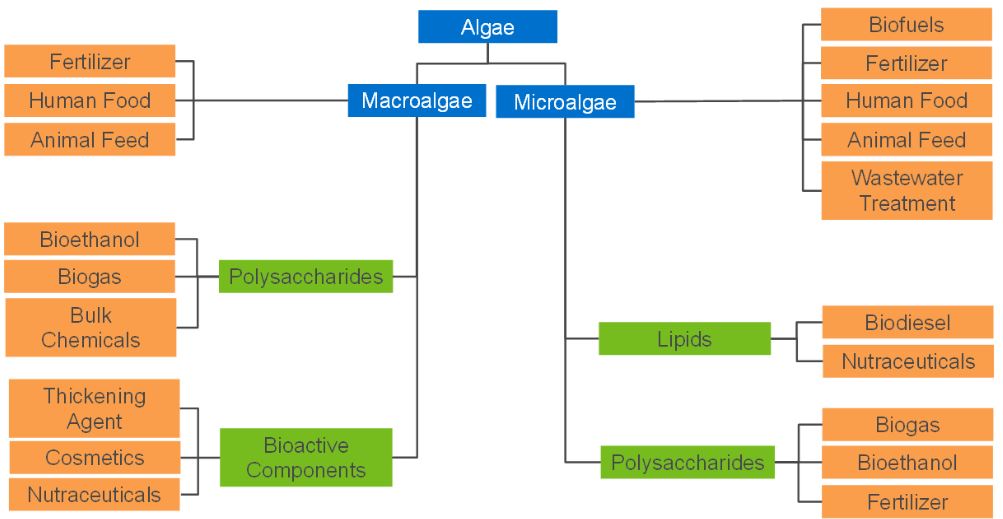
As the world work towards reducing greenhouse gas (GHG) emissions and transition towards cleaner energy sources, carbon-neutral or carbon-negative energy sources have been explored.  One such avenue is algae-based fuels, which like any other plants, absorb carbon dioxide from the atmosphere as they grow.  Its high lipid (oil) content can then be converted into biodiesel or polysaccharides (carbohydrates) that can be converted to biogas or bioethanol.  There are also other alternative uses for algae beyond fuel production that could contribute to GHG reduction by potentially substituting other products such as fertilizers that are conventionally produced from non-renewable sources. 


Figure 1.1 Algae End Uses 


While algae has similarities to other plants, with the key one being natural carbon sinks, there are a few reasons why algae has garnered more interest as a plant-based source.  Algae can: 

  • Grow in brackish water and wastewater streams 
  • Form part of a wastewater treatment system to produce clean water while terrestrial plants consume it 
  • Double its volume of biomass in mere hours under appropriate conditions 
  • Be used as a biofuels feedstock generator as well as a direct producer of biofuels and chemicals; they are known for lipids production because algae are uniquely capable among green plants of producing lipids throughout the biomass (not only in seeds) 
  • Be widely cultivated for extractable byproduct animal feed, food protein isolate, vitamins, other nutraceuticals, oleochemicals feedstocks, colourants etc. 

One of the most compelling reasons behind the interest towards algae-based fuels is their lower carbon intensity when compared to conventional fossil fuels. Their inherent carbon capture capability results in reduced greenhouse gas emissions throughout the production cycle of algae-based fuels, making them an attractive alternative to traditional fossil fuels if the economics prove workable.  

Algae’s carbon impact in reality 

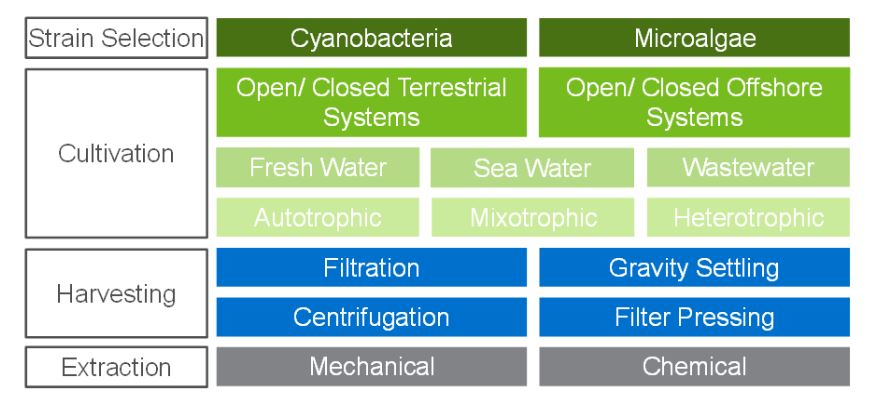
The primary determinant for achieving successful commercial production of algae-based fuels is tied to the level of oil productivity.  The pathway for generating algae oil is remarkably adaptable, offering a range of avenues that span from selecting the appropriate strains, choosing cultivation techniques, and refining the processes of harvesting and extraction.  The economic feasibility of microalgae biofuels hinges on the ability to cultivate these microorganisms on a large scale in outdoor settings. 

This cultivation can take place in open systems like ponds and wastewater facilities, as well as enclosed offshore setups such as photobioreactors (PBR).  Among these options, open pond systems are the simplest from a technical standpoint, utilizing atmospheric carbon dioxide for operation.  However, atmospheric carbon dioxide is insufficient to facilitate the rapid growth of algae needed for efficient biofuel production. Conversely, PBRs require an external supply of carbon dioxide due to their inherent design which can potentially be sourced from industry flue gases. 

The autotrophic growth (i.e. via photosynthesis) of algae is dependent on availability and intensity of light which becomes a limitation in regions with limited or consistent sunlight.  This limitation affects the scalability and productivity of algae cultivation. On the contrary, heterotrophic growth relies on external organic compounds like sugars. However, this approach increases operational costs and limits the versatility of algae cultivation as not all species are capable of heterotrophic growth.  A middle ground is found in the mixotrophic growth mechanism, which combines the advantages of both cultivation methods while mitigating their drawbacks. This approach is being embraced by companies like Next Generation Oil in Malaysia, where they employ the mixotrophic growth mechanism in their patented modular algae cultivation system known as Algae-Modular Automated Plantation (A- MAPTM).  


In order to properly assess the true carbon benefits of algae-based fuel against conventional fossil-based fuel, it is thus important to understand the differences in production approaches for algae.  As mentioned earlier, heterotrophic cultivated algae rely on sugars rather than photosynthesis and thus ends up exhibiting the highest carbon intensity among the algae production methods. Roughly two-thirds of the carbon emissions from heterotrophic algae cultivation are attributed to scope 3 emissions from dextrose, a component of the raw materials, which emit approximately 1.2 tons of CO2e per ton of whole algae. In contrast, autotrophic cultivation methods such as open pond and photobioreactor have lower carbon emissions as they consume carbon dioxide for photosynthesis.  

It is also worth noting that although algae cultivated via the autotrophic route reduces carbon emissions through the absorption of carbon dioxide from the atmosphere, the process is not without carbon emission.  Algae cultivated this way typically contains higher water content, necessitating more energy for the dewatering and drying processes. Energy is primarily supplied through fuel gas combustion, which is the primary source of carbon emissions in autotrophic cultivation methods, followed by power consumption.  

Advancement in biotechnology – the answer to algae oil productivity for biofuels? 

Despite ongoing endeavors to enhance algae cultivation techniques for boosting oil productivity, the advancement of biotechnology will be necessary to unlock the full potential of algae-based fuels. Researchers and scientists are continually refining cultivation techniques, optimising algae strains for higher lipid content (which translates to greater fuel yield) and improving overall productivity. 

Genetic engineering and synthetic biology are at the forefront of biotechnological breakthroughs in algae-based fuel production. By modifying algae strains or identifying optimum algae growth environments to enhance their lipid production capabilities, researchers are accelerating the transition from laboratory innovations to scalable, commercial solutions. These advancements not only enhance the environmental credentials of algae-based fuels but also pave the way for increased efficiency and cost-effectiveness.  Viridos, previously known as Synthetic Genomics has been focusing on algae genomic research in the last decade to improve oil productivity through gene modification and identifying a robust algae strain.   While Viridos is currently not at the stage of achieving commercial production of algae biofuels, the company has notably been one of the few algae companies that still has its focus on producing algae fuels.  

Credits fueling algae-based fuels 

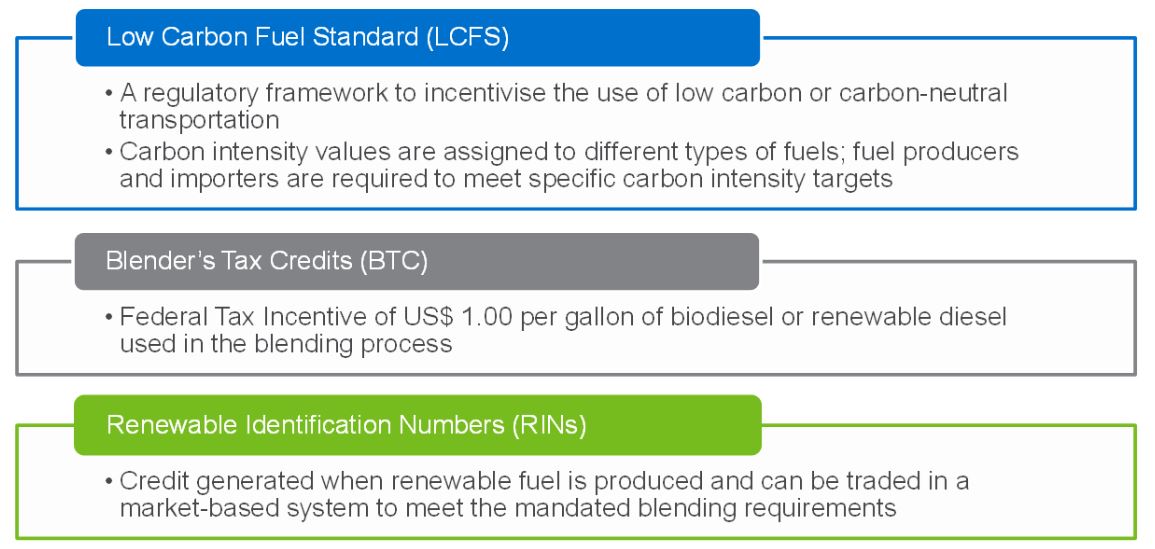
Credits serve as catalyst for advancement and play a pivotal role in propelling the development and utilisation of algae-derived fuels. These credits, encompassing a range of environmental, economic and regulatory incentives, are shaping the landscape of renewable energy by providing a foundation upon which this industry can flourish.  

Fiscal incentives are implemented in the United States to promote the use of renewable fuels in the transportation sector. These include the blender’s tax credits (BTC), Renewable Identification Numbers (RINs) and Low Carbon Fuel Standard (LCFS). While BTC and RINs are applicable for the whole country; LCFS legislation is enacted in selected states such as California, Oregon and Washington.  


Tech-driven trends: rPET’s global momentum 172 views

While nearly 400 million metric tons of plastic waste are generated annually across the globe, a mere 10% undergoes recycling. PET is a standout in the recycling landscape, enjoying one of the highest recycling rates among plastics. Its widespread presence, relative ease of collection, and inherent molecular properties make it a prime candidate for mechanical recycling. Especially in its bottled form, PET can undergo multiple reshaping and remelting cycles with minimal quality degradation. Advanced technologies like near-infrared (NIR) and optical sorting are amplifying PET’s recycling efficiency, distinguishing it more easily compared to other plastics. 

Supply, Demand and the Market Dynamics 

Despite its recyclability, a discrepancy exists between rPET (recycled PET) demand and supply. Should brands fulfill their public commitments to using recycled content, it’s anticipated that by 2030, the U.S. demand for recycled polyethylene terephthalate (rPET) will be three times greater than available supply. The main constraint in supply arises from the fact that most PET ends up in landfills, attributed to suboptimal collection rates. Yet, amid these challenges, global consciousness is shifting. Governments, industries, and consumers are increasingly echoing a unified call for sustainability. 

A Glimpse into Global Practices and Trends 

Different regions have distinct recycling practices. For instance, the U.S emphasizes curbside programs and drop-off centers, while Europe leans more towards Deposit Refund Schemes. Asia, with its diverse economic landscapes, showcases varied waste management practices. In Japan, characterized by rigorous waste segregation and one of the world’s leading recycling rates, their advanced waste management practices underscore a deep-rooted commitment to sustainability; on the other hand, in areas such as rural Cambodia, limited infrastructure often results in a reliance on open dumps and the efforts of informal waste collectors. Every region, with its unique infrastructure, priorities, and economic constraints, contributes to the larger PET recycling narrative.  

Across all regions, mechanical recycling is the more economical choice relative to advanced chemical recycling when presented with high-quality PET flake. However, chemical recycling, especially for hard-to-process feedstocks such as multi-layer plastics, heavily contaminated materials, and certain thermosets, is poised to carve out its niche, filling in the gaps where mechanical recycling lacks. 

The rPET TECH Report: A Comprehensive Guide 

For those keen on delving deeper, our Recycling Options for PET TECH report offers a panoramic view of the PET recycling world. It navigates through the intricacies of recycling processes, by exploring its technical, environmental, regulatory, and economic dynamics both globally and regionally. The report explores a spectrum of recycling technologies, detailing their methods and potential advantages. The economic competitiveness of these processes ranges from mechanical to chemical methods, with specific emphasis on solvent-based purification, glycolysis, and methanolysis. 

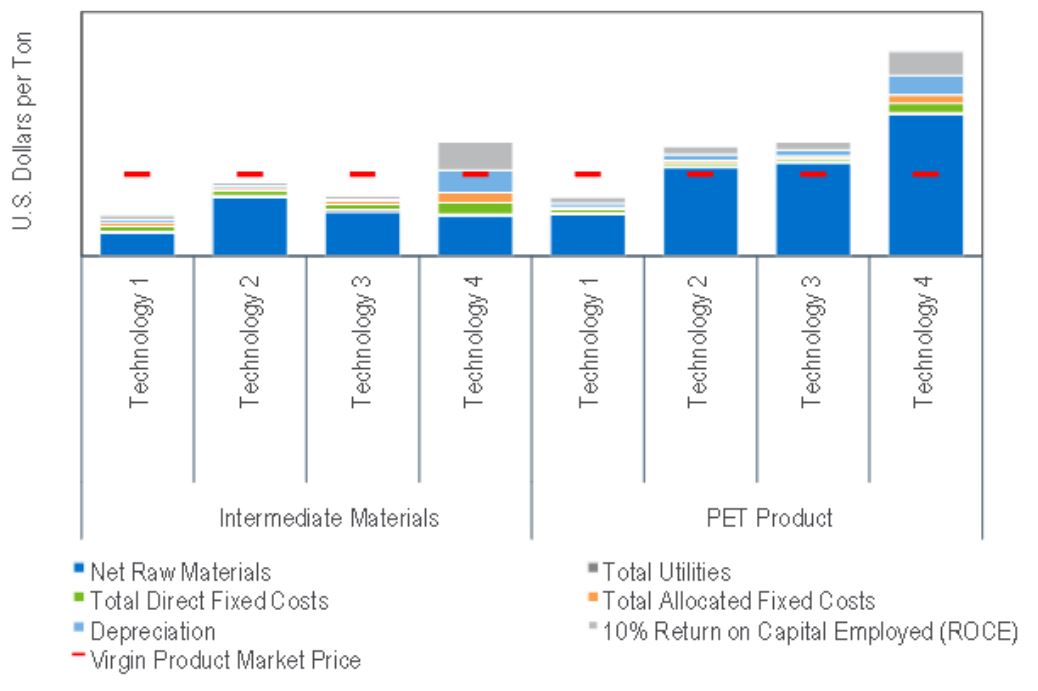
This analysis extends to detailed profiles of key technology licensors, owners, operators, and sorting technology providers, revealing the intricacies of their operations. Furthermore, the report presents a Cost of Production analysis across regions including US Gulf Coast (USGC), Western Europe, China, Japan, and Southeast Asia. These regional-specific insights spotlight market dynamics and the financial feasibility of intermediates such as rPET flakes, Bis-Het via both comprehensive and partial glycolysis, and DMT through methanolysis. The report compares rPET pellet prices with the Q1 2023 virgin market rate. 


Cost of Production Summary – United States 
(Basis: Q1 2023) 


Final Considerations 

While the path of PET recycling is laden with challenges—from supply shortages to competing with he price of tvirgin PET—the undercurrent of optimism is palpable. As public support grows, as industries recalibrate their sustainability goals, and as governments fortify their legislative mandates, PET recycling is not just a passing trend; it’s the future.  

Navigating this future necessitates informed choices. Our Recycling Options for PET TECH report is tailored to guide you through them. For those eager to garner in-depth insights and contribute to the solution, we encourage you to delve into this report. Your journey into sustainable choices begins here. 

Charting a path through the plastic waste crisis: Recycling frontiers advancing circularity 170 views

Every single item in the entire physical economy, without exception, will one day become landfill, or be incinerated.  In a world plagued by an escalating waste crisis, the urgency to find viable solutions has become paramount.  The repercussions of excessive consumption and single-use disposability has led to environmental degradation, endangered human health, and threatened biodiversity.  

Nevertheless, amidst the turmoil, there emerges a glimmer of hope. Two significant potential solutions – the proliferation of mechanical recycling and chemical recycling – are presenting extensive opportunities to revolutionize our relationship with plastic waste. Virtually all types of plastic can be recycled through these processes. However, the decisive factor for an item being “recyclable” or “recycled” rests on economics. If an item’s collection, sorting, processing, and resale value outweigh the associated costs, it gets recycled. Otherwise, these materials contribute to the mounting waste in ecosystems, landfills, or incinerators. 

The COVID-19 pandemic underscored this crucial distinction, especially with the drop in oil prices that made virgin plastics more cost-effective than recycled ones. This highlighted the subjective nature of recycling value, influenced by commodity price fluctuations. However, it also unveiled intriguing possibilities for innovation and the establishment of new recycling paradigms. 


Investor Landscape 

Despite the challenges faced by global capital markets, investments in climate technology have been on the rise. The growth in climate-related investment, driven by policies aimed at zeroing out emissions and achieving sustainability objectives, is defying market headwinds. In 2022, climate-related private-market investment surpassed the broader market in terms of deal activity, capital deployed, and flows into dedicated funds.  

The momentum is expected to continue in 2023, as governments, corporations, and investors accelerate the adoption of climate technologies. Notably, European nations are speeding up their renewable energy plans while seeking to diversify their energy supplies. Unprecedented government programs in the United States and Europe, such as the US Inflation Reduction Act (IRA) and the EU Green Deal, are set to unlock significant capital to combat climate change.  

Annual climate investments could reach $9 trillion to $12 trillion by 2030. Over the past four years, climate investing has experienced breakout growth. Equity investors have launched numerous sustainability, environmental, social, and governance (ESG), and impact funds. The cumulative assets under management in these funds have tripled from $90 billion to over $270 billion. Private-market equity investments in climate-oriented technologies and solutions have also soared, with a growth rate of 40 percent annually. 

To succeed in the climate investing landscape, investors must exercise caution and identify investment opportunities that capture tailwinds while mitigating macro headwinds.

Eight factors are crucial for assessing climate-focused deals:

  • Demonstrated technology and operational performance
  • A clear path to cost competitiveness
  • The ability to secure captive demand
  • A leadership track record
  • The ability to attract talent
  • Access to policy support and incentives
  • Readiness to hyperscale
  • The ability to create and leverage ecosystems

The waste crisis may seem insurmountable, but within its depths lies the potential for transformation. Mechanical recycling and chemical recycling have emerged as game-changing solutions, offering opportunities to reshape our relationship with plastic waste. By embracing these innovative approaches, we can breathe new life into discarded materials, reduce our reliance on virgin resources, and create a more sustainable world.  


Mechanical Recycling  

Mechanical recycling is a well-established process that converts plastic waste into reusable materials through sorting, shredding, washing, and extrusion, while keeping the chemical composition of the plastic intact. Mechanical recycling is a highly favored solution due to its energy efficiency, structured value chain, and low greenhouse gas emissions. It relies on effective waste sorting and pre-sorting systems, along with separate collection of waste streams, to produce high-quality circular polymers.  


Advanced Chemical Recycling  

Advanced chemical recycling techniques, including dissolution, depolymerization, gasification, and pyrolysis, can complement mechanical recycling by handling non-recyclable or refined waste streams. However, these techniques are less mature and have higher greenhouse gas footprints. Despite their potential to convert recycled materials into hydrocarbons and expand the range of recyclable plastics while diverting waste from landfills, the high capital intensity and expensive outputs have hindered their scalability. 

Dissolution involves dissolving plastic materials in a suitable solvent to separate the polymer from other components. Depolymerization breaks down polymers into their monomer units, while gasification converts solid plastic waste into a gaseous state through heat and controlled amounts of oxygen or steam. Pyrolysis decomposes plastic waste at high temperatures, producing gases, liquids, and char that can be used as fuels, chemicals, or further refined. 

To unlock the full potential of chemical recycling, further development of technologies, expansion of infrastructure and sortation systems, and changes in consumer behavior are necessary. Collaboration across the value chain, including partnerships between technology providers, resin producers, waste-management companies, and consumer packaged goods (CPG) companies, is crucial for scaling up advanced recycling and driving demand for recycled materials. 

Wave of change: Decarbonizing the maritime sector with low carbon intensity (CI) fuels 198 views


Decarbonization is becoming increasingly important to the global shipping industry. All materials need to be transported to and from production to market, thus shipping impacts the carbon footprint of all other sectors. Shipping companies, ship manufacturers, governments, industry organizations, and other players in the shipping and logistics value chain are following the general trend of decarbonization seen in other industry sectors.  

According to the International Energy Agency (IEA), CO2 emissions from international shipping (essentially from bunker fuel consumption) were reported to be at 706 million tons in 2022, accounting for around two percent of global CO2 emissions. Without effective decarbonization measures, the shipping industry’s greenhouse gas (GHG) footprint is projected to grow up to 130 percent of 2008 levels by 2030.   

In July 2023, the International Maritime Organization (IMO) adopted a revised GHG strategy to reduce GHG emissions from the shipping industry.  The new targets include a 20 percent emissions reduction by 2030, a 70 percent reduction by 2040 (compared to 2008 levels), and the ultimate goal of achieving net zero emissions by 2050. 

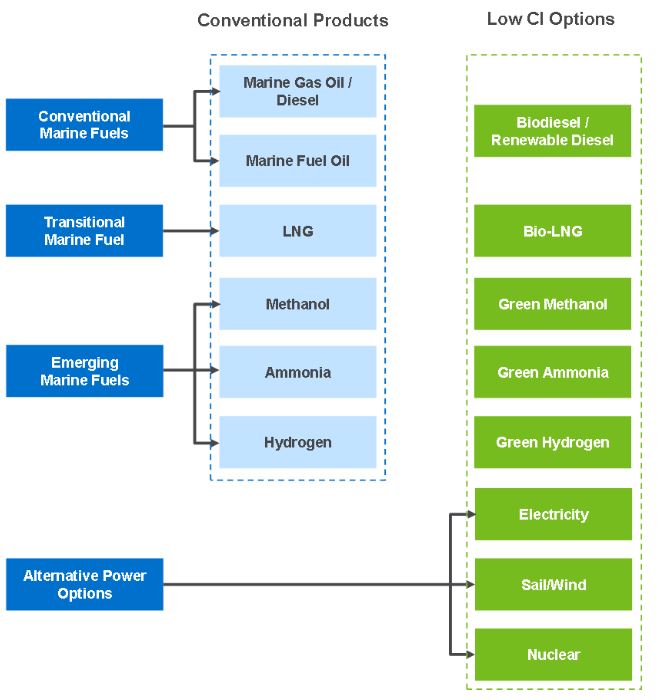
To date, the majority of cargo ships are still powered by marine fuel oil and diesel derived from crude oil, which emit relatively high CO2, SOx and NOx emissions when combusted. In recent years, liquefied natural gas (LNG) has emerged as a transition fuel between conventional marine fuels and cleaner alternatives due to its zero-sulfur content. 

As part of the industry’s ongoing decarbonization efforts, alternative fuels that emit lower GHG emissions compared to conventional marine fuels are currently being developed. Renewable drop-in fuels such as biodiesel, Renewable Diesel, and bio-LNG are already seeing limited blended use as marine fuels. Fuels with relatively low or near-zero GHG emissions, such as methanol, ammonia, and hydrogen, are considered emerging marine fuels.  The adoption of methanol remains limited to a small fraction of shipping vessels, while the use of ammonia and hydrogen is yet to be tested on actual commercial voyages. 

Alternative power options such as electricity, wind and nuclear propulsion are also being explored as viable pathways toward net zero shipping.  Technology development for these power options is still at a nascent stage, but some options like electricity and wind are already being adopted in hybrid drive systems that offer fuel-saving benefits for existing ships.  


Power Options for Shipping Vessels 


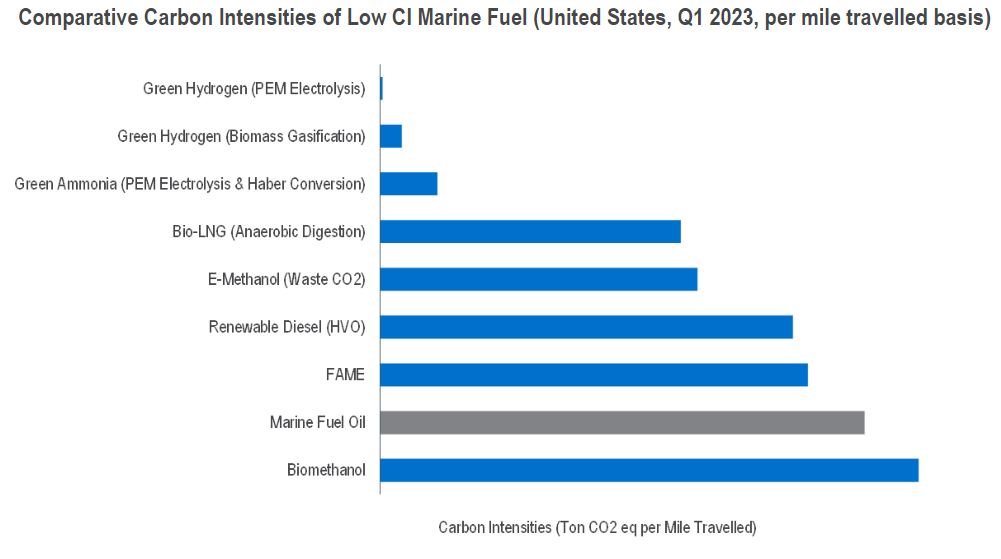
NexantECA carried out a carbon intensity analysis on a per nautical mile basis for various low CI marine fuels produced in the United States, taking into account scope 1, scope 2, upstream scope 3, and downstream scope 3 fuel combustion emissions.  The carbon intensities have been adjusted for gravimetric energy density, which is the amount of energy stored in a given mass of fuel.  This adjustment facilitates the evaluation of the environmental performance of different fuel options for specific voyages. 

The results show that green hydrogen and green ammonia rank among the marine fuels with the lowest overall carbon intensities. This is attributed to the utilization of renewable power, which has a considerably lower emission factor compared to conventional grid power generated using fossil fuels.  In addition, fuel combustion emissions (categorized as downstream scope 3 fuel combustion emissions) for hydrogen and ammonia are considered zero as they do not emit CO2 at their point of consumption. 

Other fuels such as bio-LNG, bio-methanol, e-methanol and biomass-based diesel (i.e., FAME and Renewable Diesel) have a higher carbon intensity than green hydrogen and green ammonia, as these are hydrocarbon fuels that still emit CO2 at their point of consumption, thereby contributing to significant downstream scope 3 fuel combustion emissions.  Nonetheless, the majority of the fuels produced using renewable feedstocks and renewable power (except biomethanol) still offer emissions reduction benefits when compared to conventional marine fuel oil derived from crude oil. 

Biomethanol has the highest carbon intensity on a per mile basis due to its relatively low gravimetric energy density compared to other fuels except ammonia.  This means that ships are required to carry a larger quantity of biomethanol fuel to achieve the same endurance as compared to other marine fuels, contributing to a high carbon intensity on a per mile basis.  


Conventional routes to produce emerging lower-carbon marine fuels such as methanol, ammonia, and hydrogen still rely heavily on fossil fuels.  Low carbon intensity (CI) options such as green methanol, green ammonia, and green hydrogen that are produced from renewable sources offer the potential towards zero-emissions shipping, though technology maturity and scalability of these low carbon processes need to be addressed for these options to be widely adopted in the shipping industry in the future. 

The long-term goal is to switch from fossil to non-fossil based, low CI marine fuels produced with renewable or carbon-neutral sources.  The development of low CI marine fuels, in combination with other decarbonization measures such as energy efficiency improvements in ships and onboard carbon capture, plays a critical role in achieving net zero emissions for the shipping industry by 2050. 

What’s cooking with renewable DME? 194 views


Fossil-based Dimethyl Ether (DME), traditionally derived from natural gas or coal, has a long-standing presence in the market. Global capacity has been in oversupply since the mid-2000s, largely due to significant capacity expansion in China.  China alone accounts for over 90 percent of global capacity, driven by the widespread establishment of coal-based methanol facilities during that period, as many Chinese methanol producers built DME as an integrated downstream outlet for their excess methanol.  However, recent years have witnessed a transformative shift in the form of the energy transition movement.  Bolstered by government support and industry commitments to reach carbon neutrality, this movement has ignited a fresh wave of investments aimed at advancing the scale-up and deployment of sustainable, low carbon fuels – a category that includes Renewable DME. 


What is Renewable DME? 

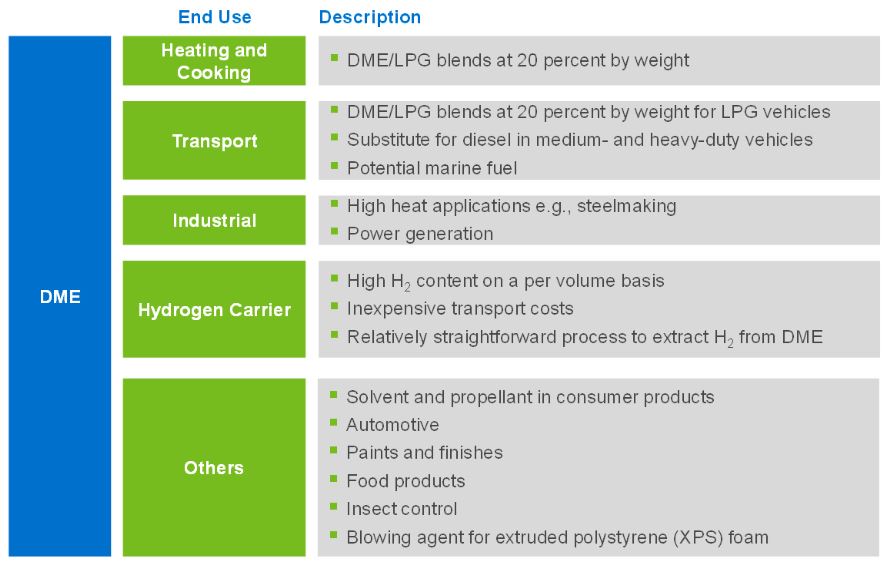
Renewable DME stands out as a safe, environmentally friendly fuel, capable of effecting Greenhouse Gas (GHG) emissions reduction swiftly, particularly in hard-to-abate sectors across remote locations.  Despite sharing the same molecular structure as fossil-based DME, Renewable DME distinguishes itself through its diverse production pathways, involving sustainable feedstocks such as biomass, waste residues, as well as renewable power and carbon dioxide.  Renewable DME can be used in different applications, as illustrated below.   


The recent upsurge in interest in Renewable DME is predominantly driven by the increasing demand for defossilisation across the transportation, domestic heating and cooking sectors.  While Renewable Liquefied Petroleum Gas (LPG) is already commercially available, its supply remains constrained due to its status as a byproduct in most production pathways.  By blending DME with LPG up to 20 percent by weight, substantial modifications to existing infrastructure are unnecessary.  This in turn simplifies processes related to storage, logistics and bottling, making it more convenient for consumers to adopt.  Furthermore, Renewable DME holds the potential as a hydrogen carrier due to its molecular structure, allowing it to transport more hydrogen on a per volume basis.  This quality positions it advantageously in the context of the growing emphasis on hydrogen as a potential “fuel of the future”. 


Industry Developments 

While still a nascent market currently, Renewable DME is undergoing a phase of rapid growth across the globe.  U.S. based Oberon Fuels became the first company to commercialise the production of Renewable DME in 2021 at the Maverick Plant in Brawley, California, using green methanol obtained from kraft pulping mill processes as feedstock.  The company plans to build more facilities in North America and Europe, with a target to achieve over 500 000 tons per year capacity by 2027. 

Dimeta, a joint venture between two major global LPG distributors – SHV Energy and UGI International, was formed to advance the production and use of Renewable DME to accelerate the decarbonisation of off-grid energy sectors.  As it stands, Dimeta has partnerships with KEW Technology, Enerkem and NextChem/MyRechemical (part of Maire Tecnimont), and is involved in a research consortium including TNO and others.  Dimeta’s joint venture with KEW Technology, known as Circular Fuels Ltd., plans to build a 50 000 tons per year plant in Teesside, United Kingdom, using Municipal Solid Waste (MSW) as feedstock.  The Teesside facility is targeted to commence commercial production by 2025.  By 2027, Dimeta is targeting the development of five other production facilities across North America and Europe, reaching a total capacity of 300 000 tons per year. 

Apart from North America and Western Europe whereby policies relating to sustainability and carbon emissions control are more mature, South Korea is also a key market for Renewable DME development.  South Korean-based Bio Friends Inc. has also announced three new Renewable DME facilities to start up within the next three to four years, all of which are located within the country.  Overall, the Renewable DME space is expected to become increasingly active in the near term, driven by the increasing need for sustainable solutions globally. 


Much like most low carbon fuels, Renewable DME is currently facing certain obstacles that need to be addressed.  These include its high production costs and the competition it faces with other higher-value, low carbon fuels for e.g. Sustainable Aviation Fuel (SAF) and Renewable Diesel, all vying for sustainable feedstocks, amongst other challenges.  Nonetheless, it is important to recognise there is currently no single solution that guarantees achievement of net zero targets within the designated timeframes (such as 2050 or 2060).  Consequently, Renewable DME assumes a crucial role in driving the global energy transition movement.  It can serve as either a standalone low carbon fuel, or leverage on the existing liquid gas supply chain, thereby effectively mitigating the costs associated with transitioning.   

Global MDI Market Snapshot 780 views

Methylene diphenyl diisocyanate (MDI) and toluene diisocyanate (TDI) are primarily used in the production of polyurethanes.  Compared to other polymers such as polyethylene, polypropylene, or PVC, polyurethane is unique.  While the other polymers have a basic backbone of repeating units, polyurethanes cannot be characterized as such.  It is easier to define polyurethanes as polymers containing urethane monomer units in their backbone, as well as other functional units such as esters, ethers, amides, ureas, and isocyanurate groups.

TDI was the first of the aromatic diisocyanates to be introduced commercially for use in polyurethane flexible foam manufacture.  It is available as a mixture of two isomers, the 2, 4 and 2, 6 isomers, with the most common grade made up of 80 percent 2, 4-TDI and known as 80:20 TDI.  This grade is typically used in the production of polyurethane foams and polyurethane CASE applications.  65:30 TDI and 100 TDI are also available and used in the production of high resilience flexible foam and CASE applications, respectively.

MDI was developed in response to the problems caused by the volatility of TDI.  TDI has a higher volatility, and in confined areas, sprayable TDI foams were difficult to handle by workers and led to health issues.  The number of transformation steps from initial refined feedstock to MDI is higher than TDI, and the chemistry used is more complex.  MDI is principally used in polyurethane and polyisocyanurate foam for construction or appliance insulation but is also used in automotive foam, coating, adhesives, sealants, and elastomers.

Methylene diphenyl diisocyanate (MDI) is produced in monomeric, polymeric, and modified forms.  There are two commodity grades of MDI that are commonly sold – monomeric MDI and polymeric MDI.  There is a significant variety in the types of modified MDI and MDI prepolymers sold to the market and they are considered specialty as they are sold on their performance.  Crude and high functionality polymeric MDI (HFPMDI) are essentially variants of polymeric MDI with higher and lower monomeric MDI content, respectively.  Blending of MDI components is also possible to produce products with specific properties. 

There are three properties that are key to choosing one of the commodity MDI grades – NCO content, viscosity, and functionality.  NCO content is a measure of the amount of free isocyanates as a function of the total molecular weight and functionality of the isocyanate and polyol.  Functionality is defined as the number of isocyanate groups per MDI molecule.  Viscosity is an important measure for processing but is also an indicator of the monomeric MDI content of the product.  Functionality of monomeric MDI is two – as there are two isocyanate groups available to react on the 4,4-MDI molecule.  The functionality of polymeric MDI is between 2 and 3 as the oligomeric species tend to cross-link by various side reactions.  This allows for greater cross-linking in polyurethanes which enhances the rigidity of the final product.

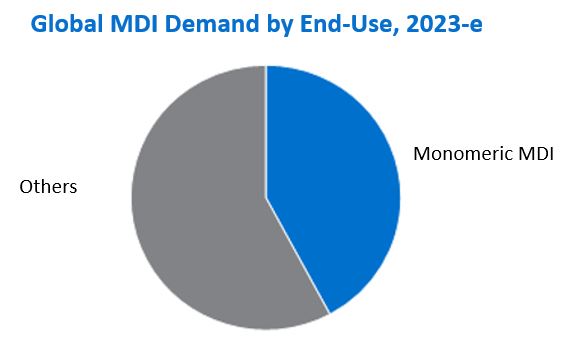
Total global MDI consumption is estimated to increase to 7.5 million tons in 2023, a two percent increase from 2022.  MDI consumption is closely linked to performance in the construction and appliance sectors which have stagnated through 2022 and 2023 due to inflation.  Demand growth is expected to remain stagnant through 2024 but improvements depend on the lowering of interest rates to help buoy demand growth.


MDI production is highly concentrated in three major regions: North America, Western Europe, and China. Global MDI capacity in 2023 exceeds 10 million tons per year, with the number of producing companies limited.  The top five producers account for nearly 90 percent of total global capacity, with Wanhua the largest global producer. Wanhua Chemicals has large MDI capacity addition plans in China until 2025 and has also added new capacity since 2022.


Is bioethanol getting a second look? 132 views

The bioethanol sector has been an important biofuel for the past decades, though it is maxing out on its addressable market.  Alcohol-to-Jet (ATJ) is unlocking a new application for ethanol, creating significant opportunities in this industry.  LanzaJet is one of the leaders providing ATJ technology focusing on the production of sustainable aviation fuel (SAF) from ethanol and other non-food feedstocks.   

Bioethanol production largely continues to be populated with first-generation ethanol (e.g., corn and sugarcane feedstocks) producers.  Concerns about competition with food resources and doubts about the environmental sustainability of first-generation processes, as a well as a search for a sustainable cost advantage over first-generation production methods, continue to motivate the development of advanced ethanol technology. 

Despite the second-generation ethanol technology (based on lignocellulosic biomass or non-food biomass such as agricultural residues) having been developed for several years, success has been difficult to achieve, with many developers exiting the sector, leaving only the most promising technologies still operating. These remaining second-generation technologies have embraced a broadly diversified set of strategies to continue the process of commercialization.  

“Third-generation” algae technology has been studied and developed for the production of ethanol through, but the studies remain to be demonstrated at commercial scale due to high capital costs and separation costs for the algal oil and co-products. 

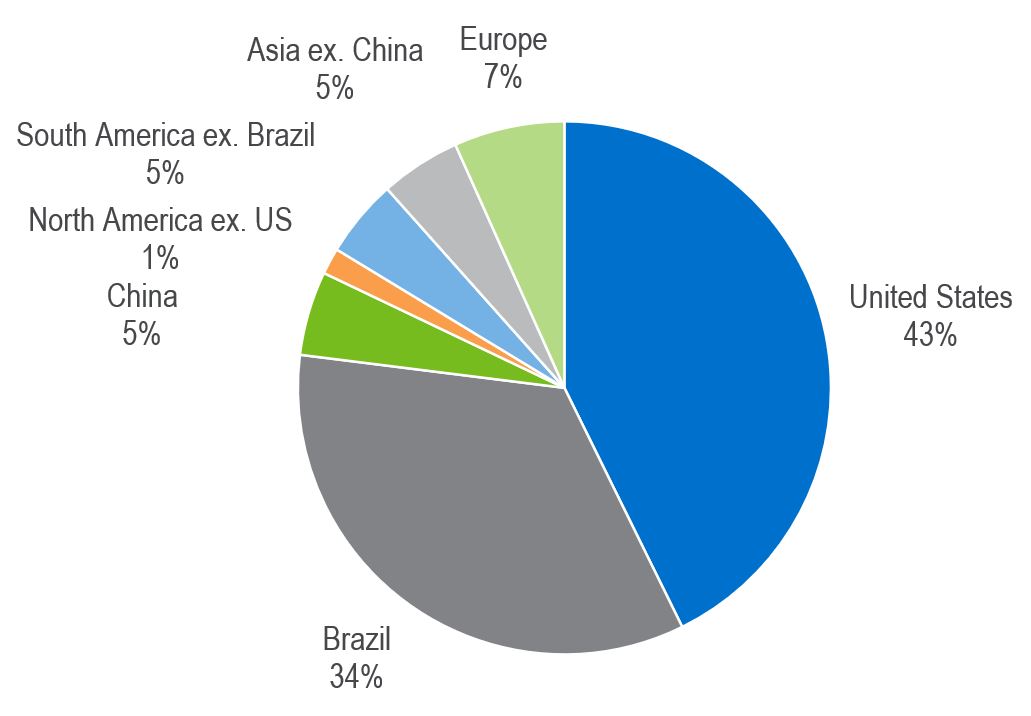
Global ethanol capacity is still concentrated in the United States and Brazil, with a combined capacity of around 84 percent.  Therefore, first-generation ethanol produced from corn and sugarcane continues to dominate global ethanol production.  In the recent development, Braskem, a prominent biopolymer producer using ethanol based route in Brazil, has partnered with a SCG Chemicals, a petrochemical in Thailand, to establish Braskem Siam Company Limited in Thailand.  The joint venture aims to produce bioethylene with a capacity of 200 000 tons per year through agricultural based ethanol dehydration.  Bioethylene will be used in the production of bio-based polyethylene.


Global Ethanol Capacity by Regions


A reduction in GHG emissions has been one of the major drivers for the development of the ethanol market.  Based on an LCA study by Renewable Fuels Association, total emissions for ethanol from corn production to the consumption of ethanol as fuel in the automobile can total to around 53 g/MJ, almost 50 percent lower than the conventional gasoline.   However, the growth for any biofuel is subject to the presence of regulatory mechanisms that serve to offset the cost of disadvantage of biofuels against the petroleum-derived products.  Effectively, all the biofuels, even at the mass scale using widely available feedstock and well-developed technology such as the first-generation ethanol, are significantly more expensive than their petroleum-based equivalents.

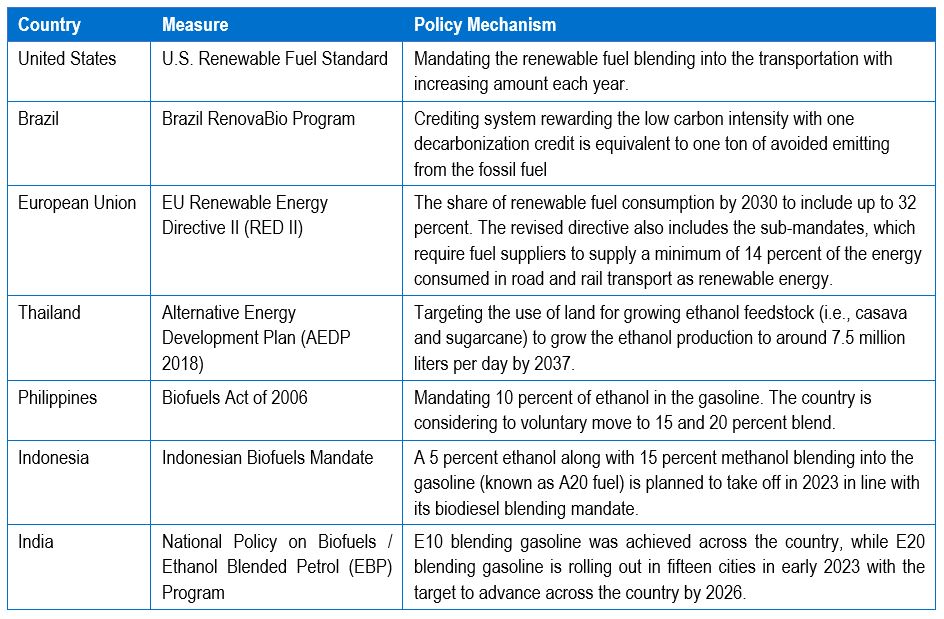
Various government policies have been increasingly discussed on ethanol as a strategic for transportation decarbonization.  A summary of the biofuels policy by major nationals that play the key role in the bioethanol market are highlighted in the table below.

A Summary of Biofuels Policy


Appointment of Chair Designate 146 views

Croda International Plc (“Croda” or “the Company”) today announces that it has appointed Danuta Gray as a Non-Executive Director and Chair Designate. Danuta will join the Board with effect from 1 February 2024 and will succeed Dame Anita Frew (DBE) as Chair at the conclusion of the Company’s AGM on 24 April 2024. Anita will then retire from the Board after nine years as Croda’s Chair.

Danuta has held Board positions with both FTSE 100 and FTSE 250 companies across a range of sectors for the past nineteen years. She is currently Chair of Direct Line Insurance Group Plc and a Non-Executive Director and Chair of the Remuneration Committee at Burberry Group plc.  She is also a member of the Employ Autism Development Board.

Danuta has extensive Non-Executive listed company Board experience having previously been Chair of St Modwen Property plc and also having served on the Boards of: Aldermore Bank plc, Old Mutual plc, Page Group plc, Paddy Power plc and Aer Lingus plc as well as a Non-Executive Member of the Defence Board of the UK Ministry of Defence.   On joining the Board, Danuta will be appointed to the Nomination Committee and will succeed Anita Frew as Chair of the Nomination Committee in April 2024.

Jacqui Ferguson, Senior Independent Director said:

“I am delighted that the comprehensive search process for our next Chair has resulted in the appointment of Danuta. Danuta is a highly experienced Non-Executive Director and Chair with a deep understanding of growing consumer focused and high technology businesses in international markets.  She has served on the Boards of a variety of listed companies and her depth of Boardroom experience and strong understanding of UK governance will be of enormous benefit to Croda.

On behalf of the Board and everyone at Croda, I would like to thank Anita for her outstanding commitment to Croda since 2014 and her leadership of the Board and stewardship during what has been a period of significant growth and strong performance”.

Danuta Gray said:

“I feel tremendous affinity with Croda given the Group’s strong customer focus, market-leading innovation and passion for using smart science to improve lives. With its talented employees, positive culture and refocused portfolio, Croda has an exciting future and I look forward to working with the Croda team to deliver on opportunities that are ahead.”

Dame Anita Frew, Chair said:

“It has been my great privilege to work with Croda and to serve as Chair of the Board since 2014 and I am delighted that I will in due course be handing over the reins to Danuta who will help steer Croda through this next phase.”

INEOS Enterprises Acquires Eramet Titanium & Iron (ETI) for $245 million. 127 views

INEOS Enterprises has today announced the acquisition of Eramet Titanium & Iron (ETA) from Eramet for $245m. The deal which takes immediate effect, was completed today following the satisfaction of regulatory approvals. ETI consists of an ilmenite transformation plant in Norway producing titanium slag which is used in the pigments industry. It also produces high-purity pig iron sold to European foundries. The business will be known as INEOS Tyssedal The agreement between Eramet and INEOS Enterprises also includes a long-term supply contract for ilmenite produced by Grande Côte Opérations (“GCO”), the Group’s subsidiary which operates the mineral sands mine in Senegal.
 
Commenting on the acquisition, Ashley Reed, CEO INEOS Enterprises said “We are very pleased to acquire ETI from Eramet. This is a good quality asset, complemented by an experienced operations team. We believe the next phase of ETI’s development can be well progressed under INEOS ownership and further improve the long-term sustainability of the company.”

Arxada Appoints Sanjeev Rastogi as Chief Executive Officer 185 views

Basel, Switzerland- September 20, 2023—Arxada, a global, science-based leader in innovative specialty chemicals, today announced the appointment of Sanjeev Rastogi as Chief Executive Officer (CEO), effective immediately. Concurrently, Marc Doyle who has successfully led Arxada since its foundation, will transition to a new role as a member of the Board of Directors. This strategic move reflects the company’s commitment to driving continuity, growth and sustainability in its portfolio.

Rastogi joined Arxada in April 2023 as president of the Consumer Microbial Control (CMC) business. With 30 years of industry experience, he has a proven track record of profitability, growing and building businesses through his strategic thinking, marketing excellence and operational expertise. Rastogi is accomplished in building high-caliber teams that execute effectively, while building sustainable portfolios. During his tenure with Arxada, he has quickly and positively impacted the CMC business, reflecting an innovation-forward and customer-centric approach. Rastogi intends to continue driving the company with a focus on the disruptive, sustainable innovations Arxada’s customers seek along with further developing  a performance-based work culture.

“I am both honored and excited to take on the role of CEO at Arxada,” Rastogi said. “It is a privilege to lead such a talented team and work alongside dedicated colleagues who are committed to delivering exceptional results. I am grateful to Marc Doyle for his strong contributions and his tireless commitment to the business. I look forward to building upon the robust foundation he has laid. Additionally, I am eager to take Arxada to its next level, together with a first-rate team, navigating the evolving landscape of our industry as we strive to be the preservation go-to within specialty chemicals.”

Before joining Arxada, Rastogi served as Senior Vice President for Hexion’s Resins and was Vice President of Honeywell’s Fluorine Products businesses. He has an MBA in finance from the Stern School of Business at New York University and a PhD in chemical engineering from the University of Delaware.

“My time with Arxada has been a unique and rewarding opportunity,” Doyle said. “I look forward to staying involved as a member of the board and know I am handing Arxada’s leadership over to very capable hands.” 

Doyle joined what is now Arxada in July 2021 upon the acquisition of Lonza Specialty Ingredients (LSI) by private equity firms Bain Capital and Cinven. His leadership was pivotal during the carve-out phase and the acquisitions of both Troy Corporation and Enviro Tech Chemical Services. The clear and concise business strategy he developed helped establish the business for its future growth trajectory. Doyle will join the board as a non-executive member and will continue to remain involved in guiding Arxada’s path forward. 

Brenntag Specialties agrees to acquire Colony Gums, strengthening Life Science portfolio in North America 135 views

  • Colony Gums is a US-based manufacturer of stabilizer blends and a blending services provider
  • This acquisition will strengthen and expands Brenntag’s services and product portfolio in Nutrition

Brenntag [ISIN DE000A1DAHH0], the leader in chemicals and ingredients distribution, today announced an agreement to acquire Colony Gums, Inc., a US-based manufacturer of stabilizer blends and a blending services provider. The acquisition is expected to complement and expand Brenntag’s product portfolio and services in Life Sciences, primarily in Nutrition.

Michael Friede, CEO of Brenntag Specialties, commented: “Colony Gums will complement our existing business and enable us to serve customers with stabilizer blends, blending solutions and hydrocolloids in our growth market of Nutrition, and other customers in Life Sciences markets globally. This is part of our ‘Strategy to Win’ to expand and fill white spots in our Life Science portfolio.” He added “I look forward to working with our new colleagues in Monroe and am excited to welcome them to the Brenntag team.”

Colony Gums is a family-owned distributor headquartered in Monroe, North Carolina. The company has grown into a specialty ingredients supplier and blending services provider over several generations, with now more than 30 employees, servicing customers in North America. In 2022, the company reported annual sales of 38 million USD.

Robert Muhlsteff, President of Colony Gums, added: ”Our team strives to enable customer growth and exceeding the expectations of our customers. I am excited to bring Brenntag customers our formulation expertise on stabilizer blends and individual hydrocolloids, and adding Brenntag’s broad portfolio of products and solutions to our offerings.”

Financial details of the deal are not being disclosed. Closing of the transaction is subject to customary conditions including regulatory approvals and is expected in Q4 of 2023.

PolyQuest To Acquire Baker Transportation 124 views

Wilmington, N.C. (September 20, 2023) – PolyQuest, Inc. (PolyQuest) announced today that it will acquire Baker Transportation, Inc. (BTI) and should close on this transaction October 1, 2023.

Baker Transportation has grown dramatically since its formation in 1987 and is one of the most dependable asset-based regional carriers in the southeastern US.  Based in Lake City, S.C., Baker is uniquely positioned adjacent to the I-95, I-20, and I-26 corridors which allows seamless access to domestic US distribution routes, as well as the ports of Wilmington, NC, Charleston, SC, and Savannah, GA.  

“Although PolyQuest will continue buying freight services from existing freight vendors, the Baker acquisition promotes extreme flexibility in tailoring freight and logistics solutions for both PolyQuest’s and Baker Transportation’s current business partners,” advised John Marinelli, CEO of PolyQuest.  “Billy and Leila Baker, along with their sons Michael and Justin, have an excellent reputation in the industry.  They will continue to oversee all the transactional aspects of this business and remain fully committed to the existing Baker Transportation customer base today and into the future.  Once the transaction is completed, the new entity name will be Baker Transportation, LLC.”

Michael Baker, VP of Operations at Baker Transportation, commented, “Over the past 20 years, PolyQuest has been a loyal customer of ours at Baker Transportation.  We are excited about what the future holds for our customers and employees and our continued growth in the transportation industry. Our primary focus over the last four decades has been to provide safe, dependable, and quality service. These core competencies will remain unchanged.”

About PolyQuest, Inc.

PolyQuest is a privately held thermoplastic resin distributor headquartered in Wilmington, North Carolina with U.S. facilities in Darlington, South Carolina; Florence, South Carolina; and Farmingdale, New York; and our European office in Austria. PolyQuest maintains a global reach offering one of the broadest resin catalogs in the hemisphere for the bottle, sheet, strapping, film, fiber, compounding, and injection molding markets. Contact us to learn more about PolyQuest as a partner for your PET, PP, PE, HIPS, and rPET materials needs and processing solutions.

Vopak reaches agreement with Infracapital on the sale of its chemical terminals in Rotterdam 113 views

Vopak reaches agreement with Infracapital on the sale of its chemical terminals in Rotterdam
 

Rotterdam, the Netherlands, 19 September 2023 08:00 CEST

Vopak announces that it has reached an agreement with Infracapital on the sale of its three chemical terminals in Rotterdam (Botlek, TTR and Chemiehaven) for a total purchase price of EUR 407 million including a conditional deferred payment of EUR 19.5 million. Total expected cash receipt net of transaction costs and net debt items at closing is around EUR 368 million. This divestment follows the strategic review as announced on 15 February 2023. The combined operational capacity of the three terminals is 1.4 million cbm.

Infracapital, the infrastructure equity investment arm of M&G Plc, is a specialist European infrastructure investor with over 20 years of experience and a proven track record of owning infrastructure assets in the Netherlands.

The transaction is subject to works council consultation and customary closing conditions and is expected to close before year end.

Vopak expects to partially reverse the cash generating unit impairment charges, recorded in 2022 related to the divested terminal assets, for an amount of around EUR 54 million to be reported as an exceptional item. FY 2022 EBITDA excluding exceptional items of these entities was approximately EUR 45 million.

Patrick van der Voort – Vopak Business Unit President Netherlands: “Although within Vopak we will surely miss our colleagues at the chemical terminals in Rotterdam, we are convinced that our customers and colleagues will be well served by partnering with Infracapital who is a long term and an experienced infrastructure investor. We would like to thank everyone involved for their trust and contribution to Vopak and will work together, with among others the works council towards a closing and smooth ownership transfer to Infracapital.”

Michiel Gilsing, Member of the Executive Board and CFO of Vopak: “The divestment of the three chemical terminals in Rotterdam is in line with our strategic goals to improve the financial performance of the portfolio, grow Vopak’s footprint in gas and industrial terminals and accelerate towards new energies. We remain committed to actively manage our portfolio towards infrastructure investments that support the long term cash flow profile and return ambitions of the company.”

Vopak’s Strategy – Shaping the future 
Our commitment to shaping a better future has led us to set ambitious goals to guide us towards 2030. Our aim is to improve the financial and sustainability performance of our portfolio. In addition, we aim to grow in industrial and gas infrastructure by investing EUR 1 billion by 2030 and to accelerate in infrastructure for new energies by investing another EUR 1 billion over the same period. We are proud to be leading the way in providing infrastructure solutions that are and will be essential to the economy and the daily lives of people around the world.

This press release contains inside information as meant in clause 7 of the Market Abuse Regulation.

About Vopak 
Royal Vopak is the world’s leading independent tank storage company. We store vital products with care. Products for everyday life. The energy that allows people to cook, heat or cool their homes and for transportation. The chemicals that enable companies to manufacture millions of useful products. The edible oils to prepare food. We take pride in improving access to cleaner energy and feedstocks for a growing world population, ensuring safe, clean and efficient storage and handling of bulk liquid products and gases at strategic locations around the world. We are excited to help shape a sustainable future by developing infrastructure solutions for new vital products, focusing on zero- and low-carbon hydrogen, ammonia, CO2, long duration energy storage and sustainable feedstocks. We have a track record of over 400 years in navigating change and are continuously investing in innovation. On sustainability, we are ambitious and performance driven, with a balanced roadmap that reflects key topics that matter most to our stakeholders and where we can have a positive impact for people, planet and profit and the United Nations Sustainable Development Goals. Vopak is listed on the Euronext Amsterdam and is headquartered in Rotterdam, the Netherlands. For more information, please visit www.vopak.com

Board Announcement – CEO Pierre-Alain Ruffieux to leave Lonza – Albert M. Baehny to step in as CEO ad interim 130 views

Basel, Switzerland, 18 September 2023 – Lonza announced today that Pierre-Alain Ruffieux, CEO, will leave the company at the end of September by mutual agreement. The Board of Directors also announced that Albert M. Baehny, Chairman, will take on the additional responsibility of Chief Executive Officer on an ad interim basis until a permanent successor is appointed.

The medium-term strategy and outlook will be discussed in detail at the Capital Markets Day in Visp on 17th October 2023.

Christoph Maeder, Lead Independent Director and Vice-Chairman, Lonza, said: “Albert has agreed to lead the Company as CEO on a temporary basis until a successor is in place, for which the Board thanks him. The search for a permanent CEO will start soon. The Board would like to thank Pierre-Alain for his service to Lonza and wishes him well in his future endeavors.”

Albert M. Baehny, Chairman, Lonza, said: “I am committed to Lonza, our employees and all stakeholders. While recent months have undoubtedly been challenging, the company is a global leader in our industry and has many opportunities for further growth across all our businesses. In the months ahead, I will ensure that we are optimally positioned to fully capture those opportunities and I look forward to working with my Board and Executive Committee colleagues.”

SIKA ANNOUNCES CHANGES TO THE BOARD OF DIRECTORS AND THE GROUP MANAGEMENT AHEAD OF THE GROWTH STRATEGY 2028 ANNOUNCEMENT 202 views

▪ Thierry F. J. Vanlancker to be proposed as new Chair of the Board of Directors at the Annual General Meeting 2024

▪ Paul Hälg has decided to step down after twelve successful years

▪ Rotation in Group Management ahead of new Growth Strategy 2028

Today, Sika announces planned changes to the Board of Directors and the Group Management. The decisions have been made ahead of the presentation of the new growth strategy at the Capital Markets Day on October 3, 2023.

Thierry F. J. Vanlancker will be proposed as new Chair of the Board of Directors at the next Annual General Meeting in 2024, as Paul Hälg has decided to step down from his position after twelve successful years to make way for a new era. Thierry F.J. Vanlancker has been a member of the Board since 2019. He has held various management positions in the chemical sector for more than 30 years and possesses in-depth knowledge of strategy, M&A, product development, sales & marketing with specific know-how in chemicals and distribution. Paul Hälg has been a member of the Board of Directors since 2009 and the Chair of the Board since 2012. During this time, Sika has seen significant profitable growth and numerous successful acquisitions and integrations, with Parex and MBCC as outstanding examples

Chief Executive Officer
“Paul has been a tremendous force and driver of our success in the past twelve years. His experience and strategic vision were crucial for Sika to become as successful as the company is now. He was especially instrumental during our historic fight for independence during a three-and-a-half-year hostile take-over battle that was resolved in June 2018. Sika and its 33,000 employees are more than grateful for his dedication and leadership as Chair of the Board during this time. Now, we are looking forward to working together with Thierry who we are convinced is a suitable successor to Paul, thanks to his broad experience in our sector and in the area of ESG.”Thomas Hasler, Chief Executive Officer

To enhance the capabilities and know-how of the Group Management in light of the new Growth Strategy 2028, the following changes to the management team will be effective as of October 1, 2023.

Christoph Ganz, currently Regional Manager Americas, is appointed Regional Manager EMEA. He joined Sika 27 years ago, has been a member of Group Management since 2007, and previously held positions in Switzerland, France, and the USA.

Mike Campion, currently Regional Manager Asia/Pacific, is appointed Regional Manager Americas. He joined Sika 25 years ago and has been a member of Group Management since 2017. He has worked in the USA and in Asia/Pacific.

Philippe Jost, currently Head Construction, is appointed Regional Manager Asia/Pacific. He joined Sika 26 years ago, has been a member of Group Management since 2019, and has held various management positions in the USA and in Switzerland.

Ivo Schädler, currently Regional Manager EMEA, is appointed Head Construction. He joined Sika 26 years ago, has been a member of Group Management since 2017, and has held managerial positions in both Switzerland and the UK.

Raffaella Marzi currently Head Human Resources & Compliance, will additionally act as Head Legal. She takes over from Stefan Mösli, who has decided to step down after successfully heading the department since 1996. Raffaella Marzi joined Sika nine years ago and has been a member of Group Management since 2020. Under her leadership, Sika has successfully integrated the Parex workforce and prepared the MBCC integration. Stefan Mösli will remain with Sika as Senior Counsel.

“We are very proud to have such a fantastic management team with so many strong leaders. Their extensive experience and dedication will successfully drive the execution of our new Growth Strategy 2028 and will further strengthen our organization. I’m looking forward to working with this team in its new setup. With these changes, we shape Sika for the years to come.”Thomas Hasler, Chief Executive Officer

INEOS announces the acquisition of the Eastman Texas City Site for ~$500 million 148 views

  • The deal includes the 600kt Acetic Acid plant and all associated third party activities on the site.
  • Eastman and INEOS have also entered into a Memorandum of Understanding to explore options for a long-term supply agreement for vinyl acetate monomer.
  • David Brooks, CEO INEOS Acetyls, comments “We are delighted to announce this strategic acquisition which will help drive our global ambitions for our Acetyls business.”


INEOS has today announced it has reached an agreement with Eastman Chemical Company to purchase the Eastman Texas City site, including the 600kt Acetic Acid plant and all associated third party activities on the site, for circa $500 million.

Eastman and INEOS have also entered into a Memorandum of Understanding to explore options for a long-term supply agreement for vinyl acetate monomer.

David Brooks, CEO INEOS Acetyls, comments “We are delighted to announce this strategic acquisition which will help drive our global ambition for our Acetyls business. The site is ideally placed to take advantage of competitively priced feedstocks which will help support the growth of our business and sustainable future of the site.“

Currently INEOS licenses its leading Cativa® Acetic Acid Technology to Eastman Chemical Texas City for production of Acetic Acid at the site.

“We are happy to have reached this agreement with INEOS. They have been a strong partner with us at the Texas City site and have extensive experience and a complementary position in the acetyls space,” said Erwin Dijkman, Division President, Chemical Intermediates.

“Our Texas City Operations is an attractive site with an incredible team of people, and we are pleased that INEOS plans to further invest in and grow the site. We look forward to working closely with INEOS as we prepare for a seamless transition later this year, and longer-term as operators of our plasticizer assets at the site.”

All current employees on the Eastman Texas City site will transfer over to INEOS upon completion of the transaction. The plasticisers unit on the site will continue to be owned by Eastman, but will be operated and maintained by INEOS from closing.

The deal is targeted to close before the end of 2023, subject to regulatory approvals

.

Stratasys Completes Sale of Urethane Facilities 128 views

Sale allows Stratasys Direct to be more focused on supporting the company’s core business while enhancing efficiency and profitability

EDEN PRAIRIE, Minn. & REHOVOT, Israel–(BUSINESS WIRE)– Stratasys Ltd. (NASDAQ: SSYS) (“Stratasys” or the “Company”), a leader in polymer 3D printing solutions, today announced that on August 31, 2023 it completed the sale of the Stratasys Direct, Inc. (“Stratasys Direct”) urethane facilities located in Poway, California to the Lamarjean Group, dba as PolyCraft Tech.

Stratasys Direct is the company’s on-demand parts service bureau. The decision to sell the non-core Urethane facilities is part of an operational transformation effort that began in early 2023 and is intended to drive better focus, accountability, internal efficiency, and speed to customer, while simultaneously improving profitability.

“The closing of this transaction demonstrates the clear, decisive action we are taking to ensure our team focuses on delivering quality and specialized products to customers around the world, and to improve the profitability of Stratasys Direct,” said Gurvinder Kahlon, General Manager and Vice President, Stratasys Direct. “Stratasys Direct has a strong foundation with a breadth of technological expertise, and I am confident in the opportunities ahead as we continue to take steps to drive stronger margins and position the business for future growth.”

“This is an important step in aligning the business to the company’s growth strategy and streamlining the organization for improved efficiency,” said Dr. Yoav Zeif, CEO of Stratasys. “The Stratasys Direct team is already improving our SAF and P3 technologies and they have grown key customer relationships through cross-selling. With even greater focus on the core strengths and technologies of Stratasys, the team will be even better positioned to provide customers with leading additive manufacturing solutions.”

About Stratasys

Stratasys is leading the global shift to additive manufacturing with innovative 3D printing solutions for industries such as aerospace, automotive, consumer products and healthcare. Through smart and connected 3D printers, polymer materials, a software ecosystem, and parts on demand, Stratasys solutions deliver competitive advantages at every stage in the product value chain. The world’s leading organizations turn to Stratasys to transform product design, bring agility to manufacturing and supply chains, and improve patient care.

To learn more about Stratasys, visit www.stratasys.com, the Stratasys blog, Twitter, LinkedIn, or Facebook. Stratasys reserves the right to utilize any of the foregoing social media platforms, including Stratasys’ websites, to share material, non-public information pursuant to the SEC’s Regulation FD. To the extent necessary and mandated by applicable law, Stratasys will also include such information in its public disclosure filings.

Stratasys, SAF, and P3 are trademarks or registered trademarks of Stratasys Ltd. and/or its affiliates. All other trademarks are the property of their respective owners, and Stratasys assumes no responsibility with regard to the selection, performance, or use of these non-Stratasys products.

Cautionary Statement Regarding Forward-Looking Statements

The statements in this press release regarding Stratasys and the transformation of Stratasys Direct, its execution and expected results and implications on Stratasys’ performance and the benefits deriving to its customers and other third parties, are “forward-looking statements” within the meaning of the Private Securities Litigation Reform Act of 1995, Section 27A of the Securities Act of 1933, and Section 21E of the Securities Exchange Act of 1934. All statements in this communication, other than statements of historical fact, are forward-looking. Such statements are based on management’s beliefs and assumptions made based on information currently available to management. These forward-looking statements involve known and unknown risks and uncertainties, which may cause Stratasys’ actual results and performance to be materially different from those expressed or implied in the forward-looking statements. For additional information about other factors that could cause actual results to differ materially from those described in the forward-looking statements, please refer to Stratasys’ periodic reports and other filings with the SEC, including the risk factors identified in Stratasys’ Annual Reports on Form 20-F, and Stratasys’ Reports of Foreign Private Issuer on Form 6-K that published its results for the quarter and six months ended June 30, 2023, which it furnished to the SEC on August 9, 2023. The forward-looking statements included in this communication are made only as of the date hereof. Stratasys undertakes no obligation to update any forward-looking statements to reflect subsequent events or circumstances, except as required by law.